


More people than ever are turning to strength training, and for good reason. Whether your goal is to build muscle, shed fat, stand taller, or simply feel more energized throughout the day, strength training delivers results that go far beyond what you see in the mirror. It is one of the most effective and accessible forms of exercise available, and you do not need a fancy gym membership or years of experience to get started.
This complete 30-day guide is designed specifically for beginners. You will learn what strength training exercises are, how to perform them safely, and how to follow a structured plan that builds real, lasting fitness. By the end of the month, you will have the foundation, confidence, and momentum to keep going long after day 30.
In a hurry? Listen to the blog instead!
What Is Strength Training?
How Strength Training Works
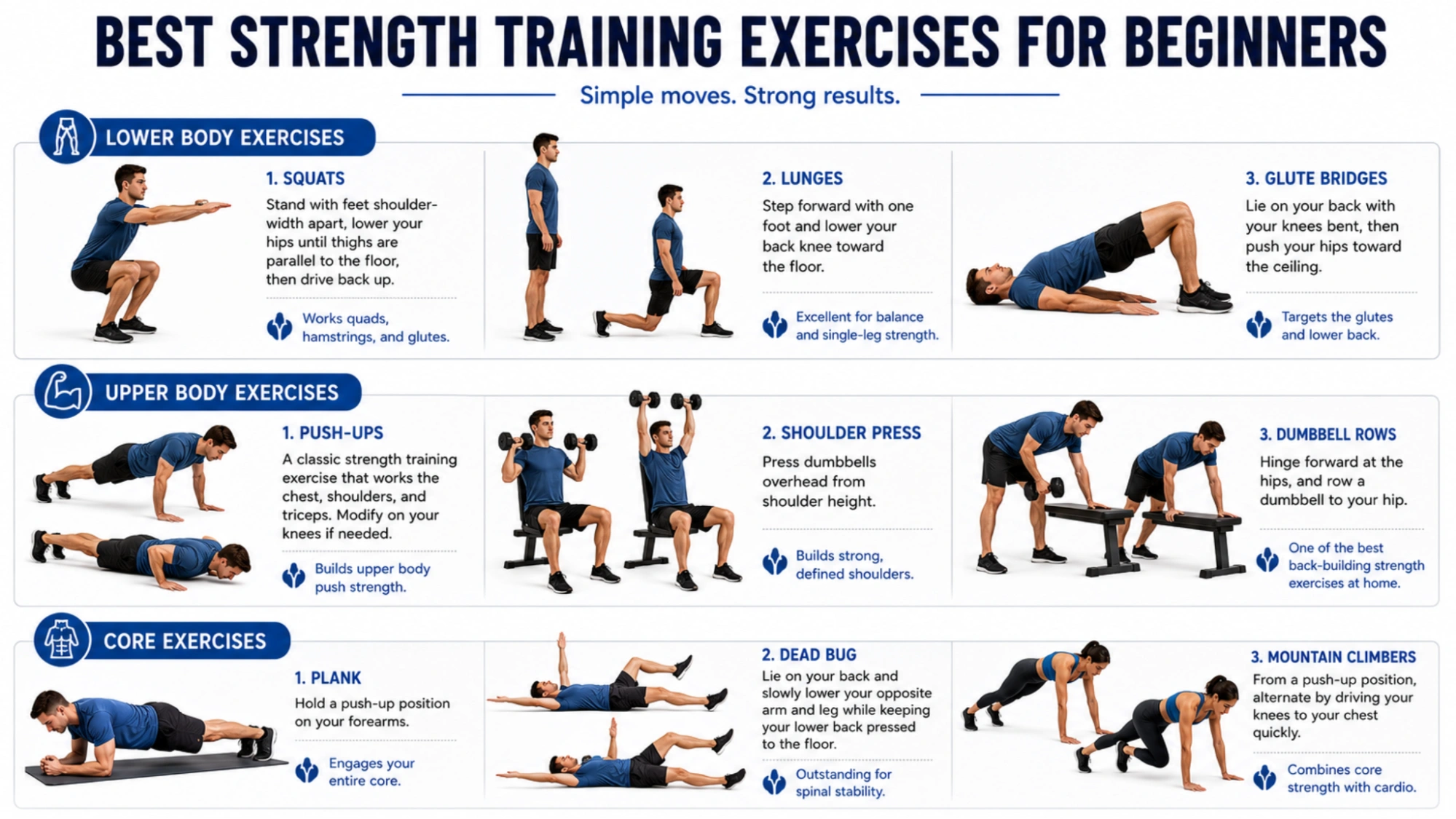
Strength training is any form of exercise that requires your muscles to work against resistance. That resistance can come from your own bodyweight, dumbbells, resistance bands, or gym machines. When your muscles are challenged, tiny micro-tears form in the muscle fibers. As your body repairs those tears during rest, the fibers grow back stronger and slightly larger. This is how you build strength over time.
The key principle that drives progress is called progressive overload, gradually increasing the demand placed on your muscles by adding more weight, reps, or sets over time. This simple concept is the engine behind every effective strength training program.
What Are Strength Training Exercises?
So, what are strength training exercises exactly? They fall into two main categories. Compound exercises work multiple muscle groups at the same time, such as squats, deadlifts, and push-ups. These give you the most value per rep and should form the backbone of your routine. Isolation exercises, like bicep curls or tricep extensions, target a single muscle group and are great for fine-tuning specific areas.
Strength training exercises can also be split into bodyweight movements (using your own weight as resistance) and weighted movements (using dumbbells, barbells, or bands). For beginners, a mix of both is ideal.
Benefits of Strength Training for Beginners
Builds Lean Muscle
One of the most immediate benefits of strength training is an increase in lean muscle mass. Even in your first few weeks, you will notice your body becoming firmer and more defined as your muscles adapt to the new demands being placed on them.
Helps Burn Fat Faster
Muscle tissue burns more calories at rest than fat tissue does. As your strength training builds more muscle, your resting metabolic rate increases, meaning you burn more calories around the clock, even when you are not exercising.
Improves Posture and Balance
Targeting the core, back, and glutes through strength training directly improves posture. Stronger stabilizer muscles also mean better balance, reducing the risk of falls and everyday injuries.
Boosts Confidence and Energy
The mental benefits of strength training are just as powerful as the physical ones. Regular training releases endorphins, reduces stress, and gives you a sense of accomplishment that carries into every other area of your life.
Supports Long-Term Health
Research consistently links strength training to better bone density, improved blood sugar control, healthier heart function, and reduced risk of chronic diseases. It is one of the best long-term investments you can make in your health.
Essential Equipment for Strength Training
Beginner-Friendly Equipment
You do not need much to get started. Here is what most beginners find useful:
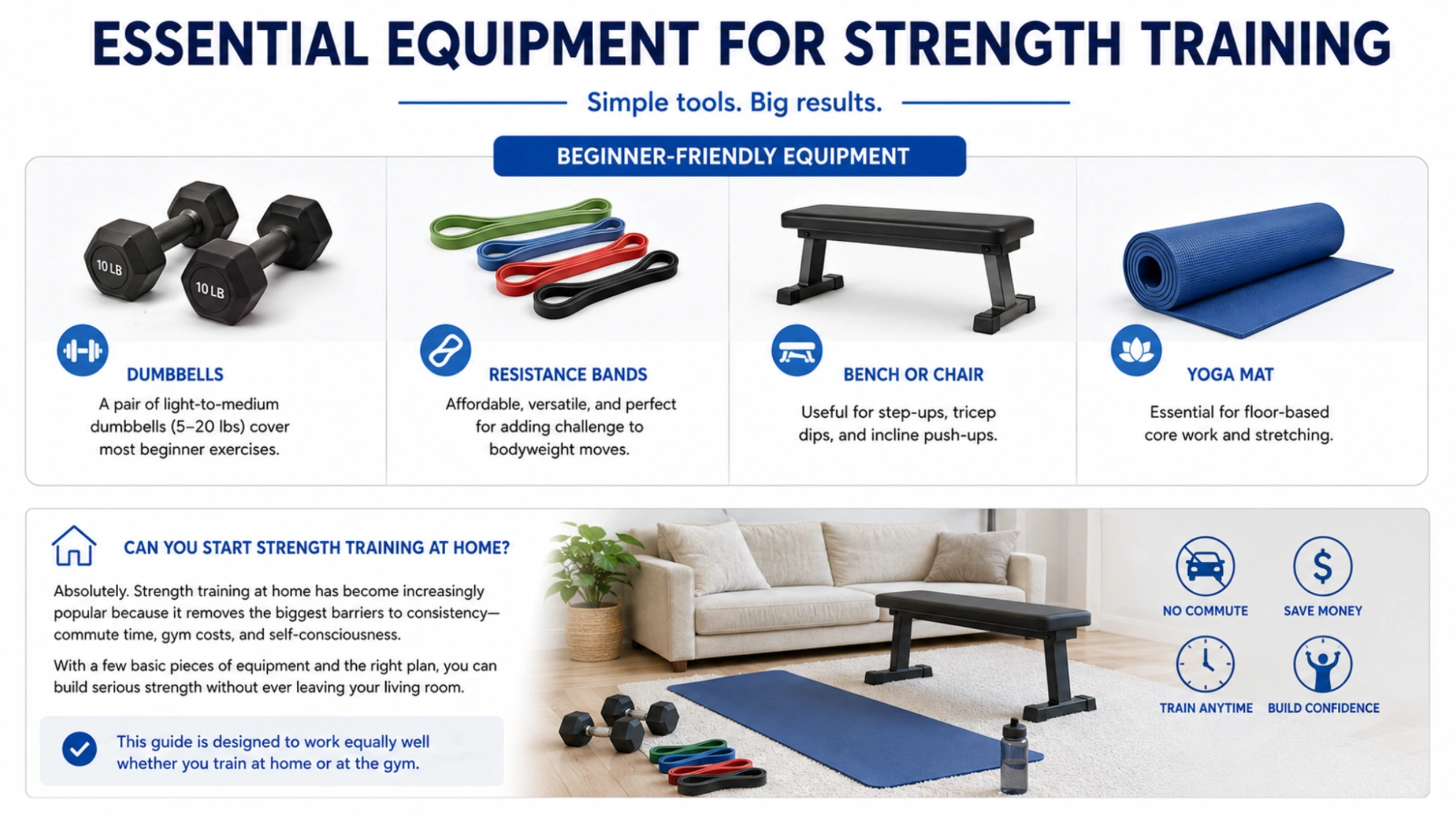
Dumbbells, a pair of light-to-medium dumbbells (5–20 lbs), cover most beginner exercises
Resistance bands are affordable, versatile, and perfect for adding challenge to bodyweight moves
A sturdy bench or chair, useful for step-ups, tricep dips, and incline push-ups
A yoga mat is essential for floor-based core work and stretching
Also Read!
What Are the Benefits of Weight Lifting?
Can You Start Strength Training at Home?
Absolutely. Strength training at home has become increasingly popular because it removes the biggest barriers to consistency, commute time, gym costs, and self-consciousness. With a few basic pieces of equipment and the right plan, you can build serious strength without ever leaving your living room. This guide is designed to work equally well whether you train at home or at the gym.
Best Strength Training Exercises for Beginners
Lower Body Exercises
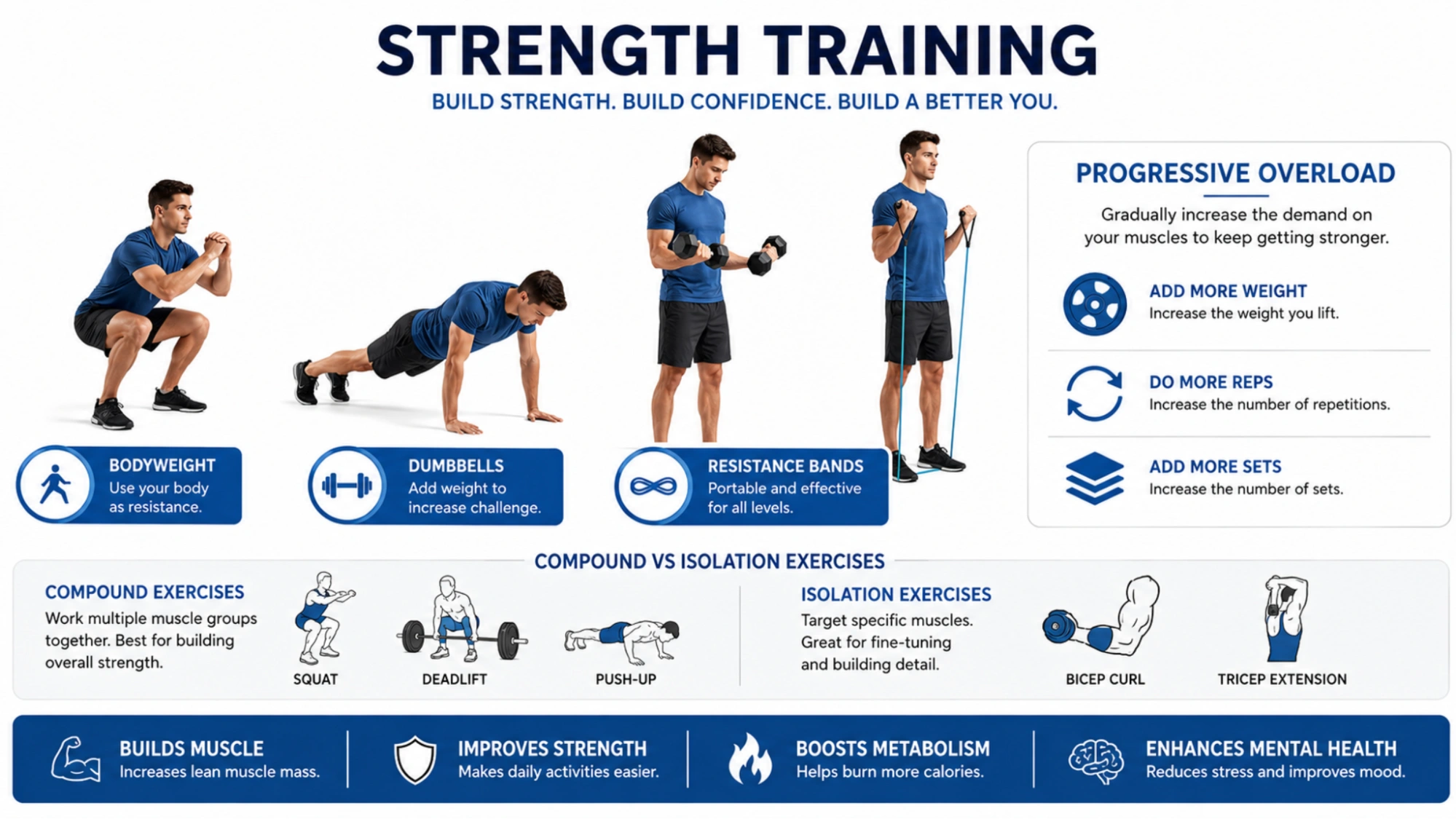
Squats are the king of lower-body movements. Stand with feet shoulder-width apart, lower your hips until thighs are parallel to the floor, then drive back up. Works quads, hamstrings, and glutes.
Lunges, step forward with one foot and lower your back knee toward the floor. Excellent for balance and single-leg strength.
Glute bridges: Lie on your back with your knees bent, then push your hips toward the ceiling. Targets the glutes and lower back.
Upper Body Exercises
Push-ups are a classic strength training exercise that works the chest, shoulders, and triceps. Modify on your knees if needed.
Shoulder press, press dumbbells overhead from shoulder height. Builds strong, defined shoulders.
Dumbbell rows, hinge forward at the hips, and row a dumbbell to your hip. One of the best back-building strength training exercises at home.
Core Exercises
Plank, hold a push-up position on your forearms. Engages your entire core.
Dead bug, lie on your back and slowly lower your opposite arm and leg while keeping your lower back pressed to the floor. Outstanding for spinal stability.
Mountain climbers, from a push-up position, alternate by driving your knees to your chest quickly. Combines core strength with cardio.
30-Day Strength Training Plan for Beginners
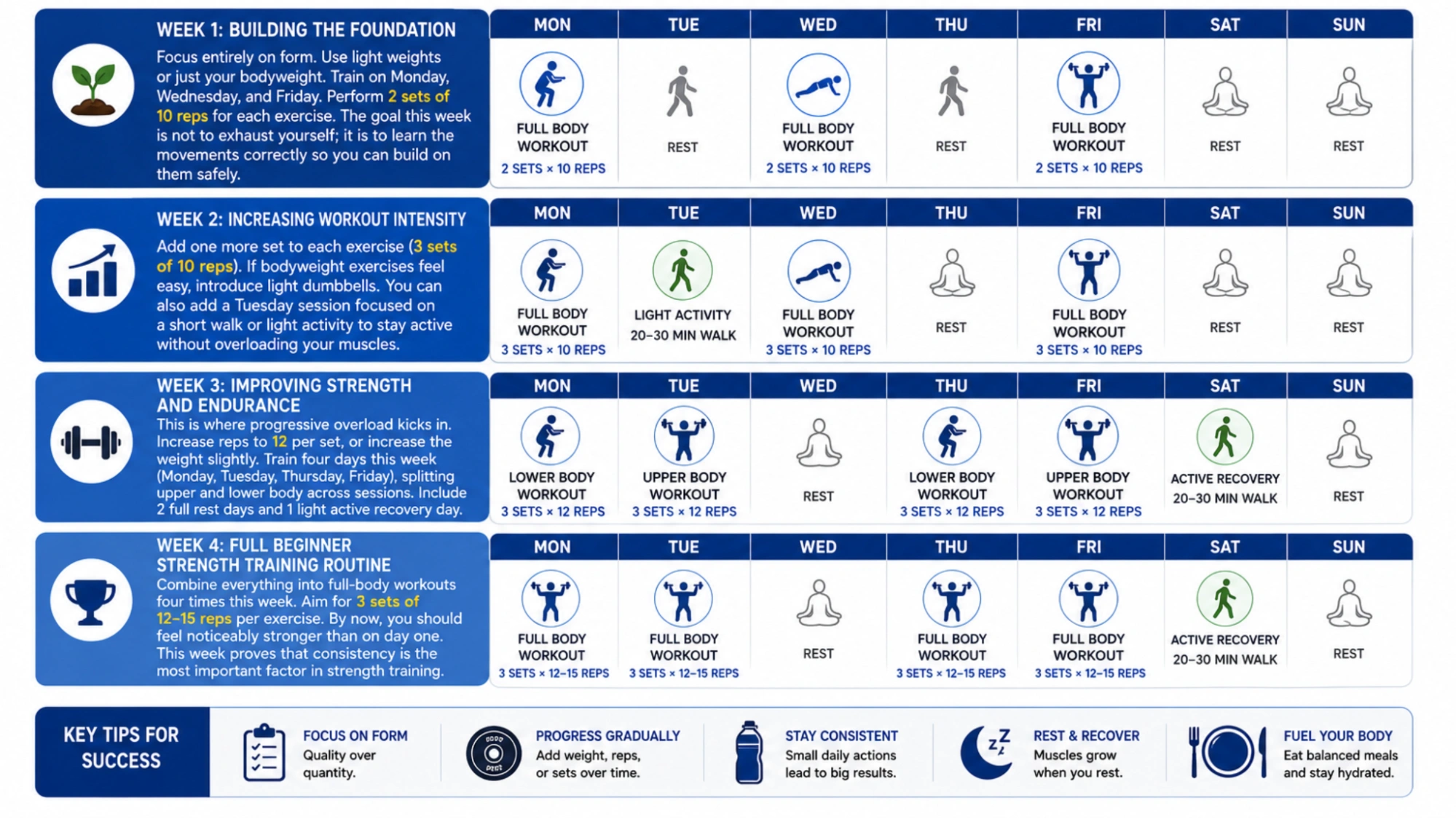
This four-week plan is structured to help you build confidence and fitness progressively. Each workout should take 30–45 minutes. Rest days are just as important as training days; your muscles grow during recovery, not during the workout itself.
Week 1: Building the Foundation
Focus entirely on form. Use light weights or just your bodyweight. Train on Monday, Wednesday, and Friday. Perform 2 sets of 10 reps for each exercise. The goal this week is not to exhaust yourself; it is to learn the movements correctly so you can build on them safely.
Week 2: Increasing Workout Intensity
Add one more set to each exercise (3 sets of 10 reps). If bodyweight exercises feel easy, introduce light dumbbells. You can also add a Tuesday session focused on a short walk or light activity to stay active without overloading your muscles.
Week 3: Improving Strength and Endurance
This is where progressive overload kicks in. Increase reps to 12 per set, or increase the weight slightly. Train four days this week (Monday, Tuesday, Thursday, Friday), splitting upper and lower body across sessions. Include 2 full rest days and 1 light active recovery day.
Week 4: Full Beginner Strength Training Routine
Combine everything into full-body workouts four times this week. Aim for 3 sets of 12–15 reps per exercise. By now, you should feel noticeably stronger than on day one. This week proves that consistency is the most important factor in strength training.
Full Body Strength Training Workout Example
Warm-Up Routine (5–10 minutes)
Never skip this step. Prepare your body with:
- 2 minutes of light jogging in place or jumping jacks
- 10 arm circles in each direction
- 10 leg swings per leg
- 10 hip circles
- 10 bodyweight squats at a slow pace
Beginner Workout Circuit
Perform each exercise for 3 sets of 10–12 reps. Rest 60 seconds between sets. These strength training exercises at home require no gym equipment:
Squats , 3 x 12
Push-ups , 3 x 10
Dumbbell rows , 3 x 10 per side
Glute bridges, 3 x 15
Plank , 3 x 30 seconds
Shoulder press, 3 x 10
Cool Down and Stretching (5–10 minutes)
Hold each stretch for 20–30 seconds: hip flexor stretch, hamstring stretch, chest opener, seated spinal twist, and child’s pose. Cooling down reduces soreness and improves flexibility over time.

Nutrition Tips for Strength Training Beginners
Importance of Protein
Protein is the building block of muscle. Aim for 0.7–1 gram of protein per pound of bodyweight daily. Good sources include chicken, eggs, Greek yogurt, legumes, tofu, and protein shakes. Without enough protein, your body cannot effectively repair and build muscle tissue after strength training.
Hydration Tips
Drink at least 8–10 glasses of water per day, and more on training days. Dehydration leads to fatigue, reduced performance, and slower recovery. Keep a water bottle nearby during every workout.
Pre-Workout and Post-Workout Meals
Eat a balanced meal 1–2 hours before training, something with carbohydrates for energy and protein for muscle support (e.g., oats with eggs or a banana with peanut butter). After your workout, refuel within 30–60 minutes with a protein-rich meal or shake to support muscle repair and recovery.
Track Your Progress Smarter with Calorie Tracker Buddy
Staying consistent with your fitness journey becomes much easier when you can track your meals, calories, and daily habits in one place. Calorie Tracker Buddy is a beginner-friendly calorie tracking app that helps users monitor food intake, calorie burn, hydration, and overall fitness progress without making the process feel complicated. It combines AI-powered meal tracking with a fun virtual buddy system that keeps you motivated throughout your journey.
Features of Calorie Tracker Buddy
- AI meal scanning to instantly estimate calories and nutrition from food photos
- Easy calorie and macro tracking for protein, carbs, and fats
- Menu scanner that helps users make smarter restaurant choices
- Personalized goal insights based on weight loss, maintenance, or fitness goals
- Hydration tracking with smart reminders
- Daily progress reports and habit tracking
- Virtual “Buddy” motivation system that rewards healthy food and consistency
- Beginner-friendly interface designed for simple everyday use
- Available on both Android and iOS platforms
Common Strength Training Mistakes Beginners Make
This makes the tool feel like a practical solution :
- Your blog first explains workouts and recovery
- Then it talks about nutrition and protein intake
- After that, introducing a calorie tracking tool feels natural and helpful
- It improves the flow without sounding promotional too early
Recommended structure:
- Nutrition Tips for Strength Training Beginners
- Track Your Progress Smarter with Calorie Tracker Buddy ← Add here
- Common Strength Training Mistakes Beginners Make
- Strength Training at Home vs. the Gym
This makes the tool feel like a practical solution for beginners who want to stay consistent with their diet and fitness goals.
Common Strength Training Mistakes Beginners Make
Skipping Warm-Ups
Jumping straight into heavy strength training exercises without warming up dramatically increases injury risk. Always give your muscles and joints time to prepare.
Using Too Much Weight
Ego lifting, using more weight than you can control, is one of the fastest routes to injury. Start lighter than you think you need to, nail the form, and add weight gradually.
Poor Exercise Form
Bad form not only reduces the effectiveness of your strength training exercises, but it can also cause serious injury over time. When in doubt, slow down and focus on control over speed or weight.
Not Resting Enough
Rest days are not a sign of weakness. Muscles grow during recovery, and chronically skipping rest days leads to overtraining, burnout, and injury. Aim for at least 1–2 full rest days per week.
Strength Training At Home Vs The Gym
Benefits of Home Workouts
Strength training at home is convenient, private, and cost-effective. There is no commute, no waiting for equipment, and no intimidation factor. With a few dumbbells and resistance bands, you can perform an enormous variety of strength training exercises at home that deliver real results.
Benefits of Gym Training
Gyms offer access to heavier equipment, greater exercise variety, and a motivating atmosphere. If you enjoy structure and social settings, a gym environment can push you to work harder and stay more consistent.
Which Option Is Better for Beginners?
The best option is whichever one you will actually stick to. If strength training at home removes the friction of getting to a gym, start there. You can always transition to a gym once training becomes a habit. The fundamentals are the same wherever you train.
Conclusion
Strength training is one of the most transformative habits you can build. In just 30 days, following the plan in this guide, you will be stronger, more energized, and equipped with skills you can build on for life. You do not need to be perfect; you just need to be consistent.
Progress takes time, and every rep you complete is an investment in your future self. Start with what you have, where you are, and trust the process. The version of you at the end of this 30-day plan will thank you for starting today.
Ready to begin? Download the full workout plan, join our newsletter for weekly tips, or take on the 30-day beginner challenge today. Your strongest self is waiting.
FAQs About Strength Training
How Often Should Beginners Do Strength Training?
Three days per week is ideal for beginners. This gives you enough frequency to build momentum while allowing your muscles sufficient recovery time between sessions.
Can I Do Strength Training Every Day?
Not recommended for beginners. Your muscles need 48 hours to recover after a session. Training every day without rest increases injury risk and can actually slow your progress. Rest days are a critical part of the program.
Is Strength Training Good for Weight Loss?
Yes. While cardio burns calories during exercise, strength training raises your metabolic rate so you burn more calories all day long. Combined with a balanced diet, it is one of the most effective tools for sustainable fat loss.
How Long Does It Take to See Results?
Most beginners notice improved energy and strength within two to three weeks. Visible muscle changes typically appear after six to eight weeks of consistent training. Stick with it; the results compound over time.
Can Beginners Start Strength Training at Home?
Absolutely. This entire 30-day guide is designed with home training in mind. All the exercises covered can be performed as strength training exercises at home with minimal equipment. Many beginners find starting at home far less intimidating than walking into a gym for the first time.