


If there is one question I get asked more than any other on the gym floor, it is this: “What should my workout schedule actually look like?”
People come in with conflicting advice from every direction. Train one muscle a day. Train everything every day. Lift heavily. Lift light with more reps. Six years of coaching have taught me that for the vast majority of people, especially beginners and anyone with a busy schedule, the answer is refreshingly simple. A well-structured body workout that hits every major muscle group in a single session is the most efficient, sustainable, and genuinely effective approach available.
This guide breaks down everything you need to know: what a full body workout actually is, why it works, how to structure one properly, and a complete routine you can start using this week.
Listen To The Podcast Now!
What Is a Full Body Workout?

Let me answer this directly because the term gets used loosely.
A full body workout is a training session that targets all major muscle groups, arms, back, chest, core, shoulders, glutes, quadriceps, hamstrings, and calves, in one sitting, using a combination of compound exercises. Rather than dedicating an entire session to just legs or just upper body, you train your whole body in a single, well-structured workout.
This stands in contrast to split routines, where you separate muscle groups across different days. A typical split might dedicate Monday to chest and triceps, Wednesday to back and biceps, and Friday to legs. Both approaches can build muscle and strength effectively. The right choice depends entirely on your schedule, experience level, and goals.
For most beginners and anyone training two to three times per week, a full body workout is the smarter starting point.
Why Full Body Workouts Work So Well
Efficiency Without Sacrificing Results
The biggest advantage of a full body workout is efficiency. Even if you can only make it to the gym two or three times a week, you still work every major muscle group and get comparable strength and muscle-building benefits to more complicated split workout routines.
Research backs this up clearly. A 2021 study found that full body and split routines were equally effective for strength and muscle growth, provided weekly training volume was matched. The structure matters less than consistency and total work done over time.
Better Calorie Burn
Evidence also shows that full body workouts typically burn more calories per session compared to split workouts, since you are engaging more muscle mass within a single training window. If your goals include fat loss or weight management alongside building strength, full body training gives you both benefits simultaneously.
Built-In Recovery
By distributing training across the entire body rather than hammering one muscle group repeatedly, full body workouts naturally build in recovery time between sessions. Your muscles get adequate time to repair and rebuild, which is when actual growth happens. Training a muscle group too frequently without recovery often backfires, leading to fatigue rather than progress.
Genuinely Time-Efficient
A complete full body session can be finished in 30 to 60 minutes, depending on your experience level. For people juggling work, family, and a dozen other priorities, this matters enormously. A workout you can actually fit into your week beats a theoretically perfect routine you never have time for.
The Key Movement Patterns
Every effective body workout is built around three fundamental movement categories.
Push exercises include chest presses, push-ups, and overhead presses. These strengthen your chest, shoulders, and triceps, mirroring the motion of pushing yourself away from the ground or pressing something overhead.
Pull exercises include rows, pull-ups, and lat pulldowns. These engage your upper back and biceps, similar to rowing a boat or pulling a cord.
Lower body movements like squats and lunges strengthen your quads, hamstrings, and glutes. You use this pattern constantly in daily life, whether climbing stairs or stepping up a curb.
A properly balanced full-body session includes all three patterns, ensuring no muscle group gets neglected.
Also Read
Full Body Workout Routine for Beginners
Here is a complete beginner-friendly routine I regularly give to new clients. Perform these two to three times weekly with at least one rest day between sessions.
Warm-Up
Start with five to ten minutes of light cardio, such as brisk walking or jogging in place. Follow with dynamic stretches like walking lunges with a twist, arm circles, and leg swings to prepare your joints and muscles for the work ahead.
The Workout
Perform two to three sets of 8 to 12 repetitions for each exercise, resting 30 to 60 seconds between sets.
Squats: Stand with feet shoulder-width apart, holding dumbbells if available. Lower into a seated position while keeping your back straight and knees tracking over your toes. Push back up through your heels.
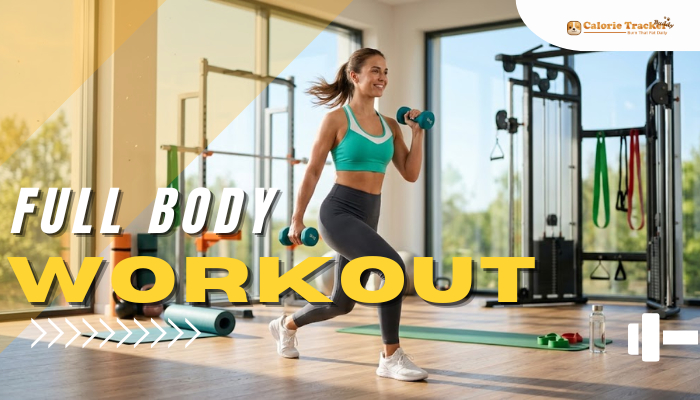
Alternating Lunges: Step forward with one leg, bending both knees to 90 degrees. Push through your front heel to return to standing, then repeat on the other side.
Bicep Curls: Holding dumbbells at your sides, curl the weights toward your shoulders without swinging, then lower slowly.
Tricep Dips: Using a sturdy chair or bench, lower your body by bending your elbows to 90 degrees, then push back up using your triceps.
Lat Pulldowns or Bodyweight Rows: Pull a bar or your own bodyweight toward you, squeezing your back muscles, then return slowly to the start.
Cable Rows or Table Rows: Row toward your chest while squeezing your shoulder blades together, then release with control.
Cool Down
Finish with stretches for your quads, hamstrings, chest, back, shoulders, and arms, holding each for 15 to 30 seconds to support recovery and flexibility.
Intermediate and At-Home Variations
Once the beginner routine feels manageable, you can progress to more advanced workout routines using heavier compound lifts.
An intermediate strength-focused session might include front squats for four sets of 6 to 8 reps, incline bench press for four sets of 6 to 8 reps, single-arm dumbbell rows, an Arnold press variation, barbell hip thrusts, and weighted chin-ups taken close to failure.
If you train at home without gym access, dumbbells, kettlebells, or simple bodyweight substitutions work just as well. A solid at-home routine includes goblet squats, push-ups, bent-over rows, shoulder presses, glute bridges, and a plank hold to finish.
What Are the Best Workout Routines for Your Goals?
The honest answer is that the best workout routines depend entirely on your experience level, schedule, and specific goals.
Beginners benefit most from full body sessions two to three times weekly using lighter weights and machine-based exercises that guide proper form while confidence builds.
Intermediate lifters often do well with three full body sessions weekly, gradually shifting toward free weights and heavier compound lifts as strength improves.
Advanced lifters or those training four or more times weekly may benefit from split routines that allow greater focus and volume on individual muscle groups, provided recovery, nutrition, and sleep are prioritized alongside the increased training frequency.
There is no single universally best approach. The best routine is the one you can perform consistently with good form and progressive overload over months and years.
The Principle That Makes Any Routine Work: Progressive Overload
Regardless of which body workout structure you choose, one principle determines whether you actually get stronger over time: progressive overload.
This simply means gradually increasing the demand placed on your muscles. You can do this by adding weight once you complete all sets comfortably, by adding repetitions before increasing weight, or by adding additional sets for extra volume. Without this gradual increase in challenge, your muscles adapt to the current stimulus and stop improving, regardless of how consistently you show up.
Tips for Full Body Workout Success

Always warm up and cool down properly. Five to ten minutes preparing your body before training and five minutes stretching afterward genuinely reduces injury risk and supports recovery.
Prioritise rest days between sessions. Strength training causes microscopic damage to muscle fibres, and the repair process that happens during rest is what actually builds strength and size.
Focus on form before adding heavy load. Poor technique increases injury risk and slows progress far more than starting with lighter weights and proper movement patterns.
Keep your routine balanced across all major muscle groups rather than favouring exercises you enjoy most. A genuinely effective full body session trains your whole body, not just your favourite parts.
Track Your Progress With Calorie Tracker Buddy

Here is something I tell every client starting a new body workout routine: training consistently is only half the picture. What you eat around your sessions determines whether all that hard work actually shows up as visible results.
Most beginners drastically underestimate how much fuel a full body session actually demands, or they undereat protein and wonder why recovery feels slow. This is exactly where Calorie Tracker Buddy becomes a genuinely useful companion to your training.
Snap the Meal: Point your camera at your pre or post-workout meal, tap once, and it is instantly logged with full calorie and macro breakdown. No manual searching after a tiring session, just quick, accurate tracking.
Calorie Intake Tracker: See in real time how your meals are supporting your training goals, whether that is fueling performance, supporting recovery, or managing weight alongside your workouts.
Calorie Burn Tracker: Full body workouts burn meaningful calories per session. This feature accounts for your training output alongside daily movement, giving you an accurate picture of total energy expenditure rather than guessing.
Goal Predictions: Whether your goal is fat loss, muscle gain, or general fitness, see in real time how your current eating and training combination is trending toward that outcome.
Buddy Motivation: Your virtual pet grows with every healthy choice you make, alongside every workout you log. On days when motivation dips, that small nudge often makes the difference between skipping and showing up.
Social Sharing: Share your training and nutrition wins with your gym community. Accountability from others consistently improves adherence to both workouts and eating habits.
Pairing a structured body workout routine with consistent nutrition tracking is what separates people who see steady, visible progress from those who train hard but never quite get the results they are working for.
FAQs
Q1. What is a full body workout exactly?
A full body workout is a training session that targets every major muscle group, including arms, chest, back, shoulders, core, and legs, within a single session using compound exercises like squats, presses, and rows.
Q2. How many times a week should I do a full body workout?
Beginners typically see good results from two sessions weekly. Intermediate lifters often find three sessions per week to be the sweet spot. Advanced trainees can handle four sessions if recovery, nutrition, and sleep are well managed.
Q3. What are the best workout routines for someone just starting out?
Machine-based full body routines with lighter weights are ideal for beginners, since machines guide proper movement patterns and reduce injury risk while confidence and strength build.
Q4. Is a full body workout good for weight loss?
Yes. Full body training builds lean muscle, which raises resting metabolism over time, and burns more calories per session than isolated muscle group training due to the larger amount of muscle mass engaged simultaneously.