

If you’ve ever opened a calorie tracking app with full motivation and then closed it five minutes later out of frustration, you already understand the problem.
You search for a simple meal. Nothing matches exactly. You start combining entries. Then comes the real confusion, was that one cup of rice or slightly more? Did you add oil? How much? At some point, you stop tracking accurately and start guessing.
That’s Manual logging in real life.
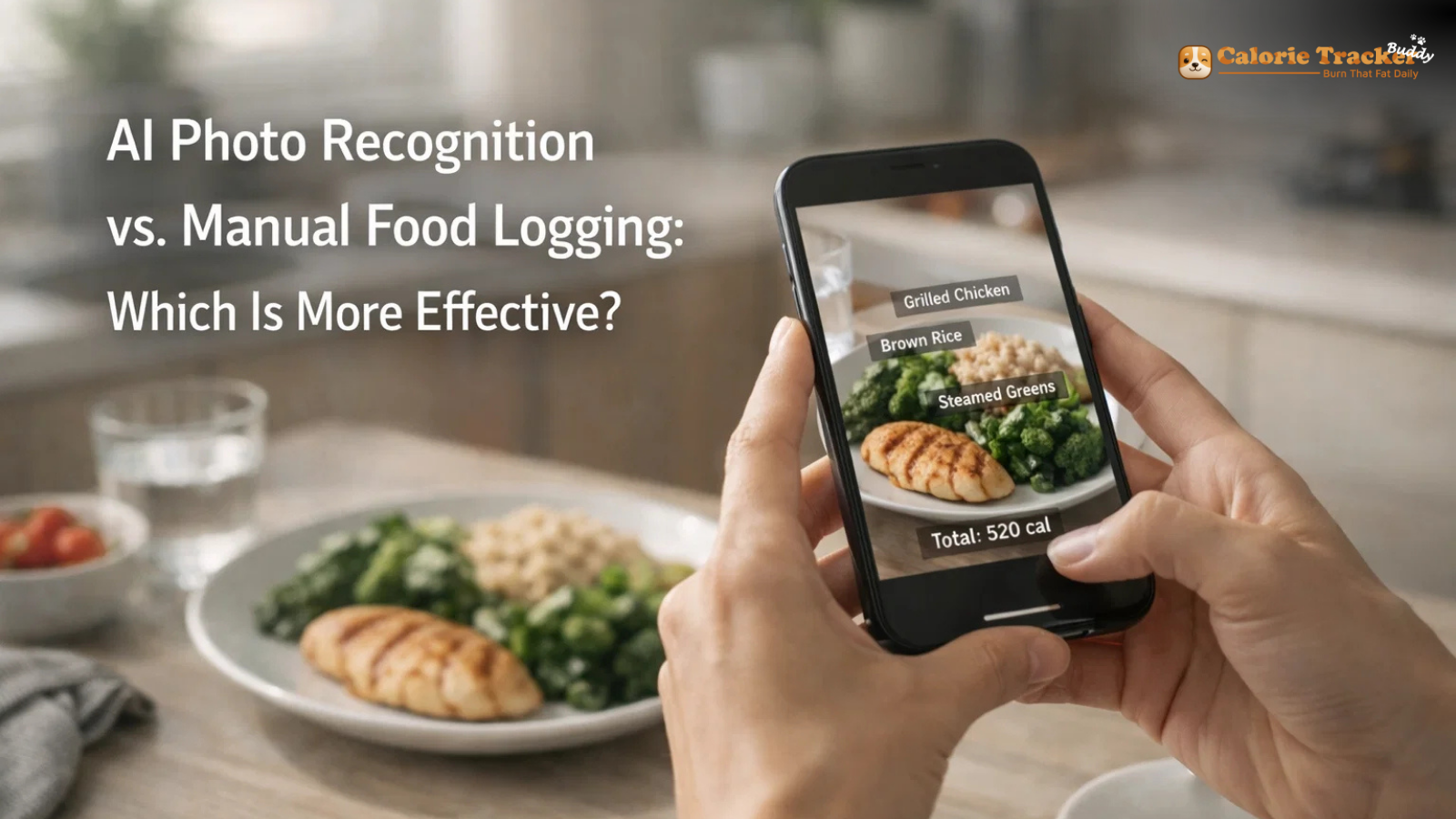
Now enter AI Photo Recognition. You click a photo, and within seconds, your food is analyzed. Calories, macros, ingredients. No searching. No guessing.
Sounds like a dream, right?
But here’s the real question:
Is it actually better, or just more convenient?
Let’s break it down in a way that actually helps you decide.
Listen To The Podcast Now!
The Reality of Manual Logging (That No One Talks About)

Manual logging has been the backbone of calorie tracking for years. It’s trusted, widely used, and recommended by fitness experts.
But behind that reputation, there are some uncomfortable truths.
1. It’s Not as Accurate as You Think
Most people assume that manually entering food equals accuracy. In reality, it depends entirely on your estimation skills.
And humans are not great at estimating food.
From portion sizes to hidden ingredients, errors creep in everywhere. A little extra oil, a slightly bigger serving, or an incorrect database entry can throw off your entire day.
Over time, these small errors stack up.
That’s why many people feel like they’re “doing everything right” but still not seeing results.
2. Portion Size Is the Biggest Problem
Let’s be honest. When was the last time you measured your food perfectly?
A bowl of pasta can vary massively depending on how it’s served. Even something simple like peanut butter can double in calories with just one extra spoon.
Without a food scale, most people rely on visual guesses. And those guesses are often wrong.
This is where Manual logging starts losing its edge.
3. It Takes Too Much Effort
Consistency is everything in nutrition tracking. But consistency requires effort.
- Searching for foods
- Selecting the right entry
- Adjusting quantities
- Repeating this for every meal
It adds up.
What starts as motivation slowly turns into friction. And friction is the reason most people quit within days.
4. Database Confusion Is Real
Most apps rely on massive food databases. Sounds helpful, but it creates another problem.
Multiple entries for the same food
Incorrect nutritional values
User-submitted data with errors
You end up choosing the “closest match” instead of the correct one.
And that defeats the whole purpose of tracking.
What Makes AI Photo Recognition Different?
Now let’s flip the perspective.
Instead of typing, searching, and estimating, you just take a photo.
That’s the promise of AI Photo Recognition.
But what’s happening behind the scenes is where things get interesting.
1. It Understands Food Visually
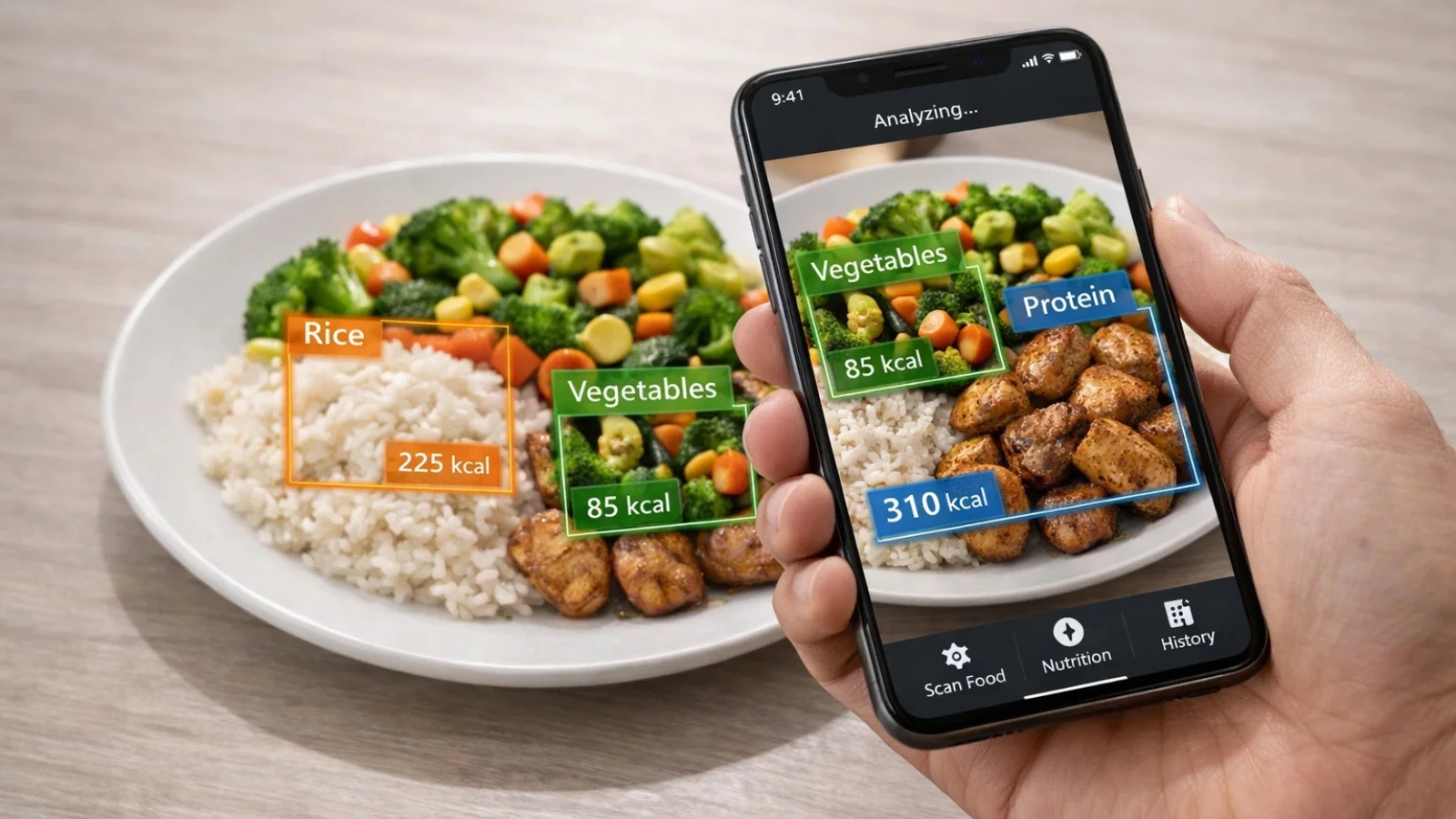
Modern systems are trained on millions of food images. They recognize patterns, textures, colors, and even plating styles.
So when you snap a picture, the system doesn’t just see “food.” It identifies components.
- Rice
- Chicken
- Vegetables
- Sauces
Each element is analyzed separately.
That’s something manual logging simply can’t do in one step.
2. It Estimates Portions Automatically
One of the biggest advantages of AI Photo Recognition is portion estimation.
Instead of guessing whether your serving is 100 grams or 200 grams, the system uses visual depth, plate size, and context to make an estimate.
Is it perfect? No.
But for the average user, it’s often closer than a random guess.
3. Speed Changes Everything
Manual logging can take several minutes per meal.
AI reduces that to seconds.
This isn’t just about convenience. It directly impacts behavior.
When something is quick and effortless, you’re far more likely to stick with it.
And in fitness, consistency beats perfection every single time.
- It Reduces Mental Load
Tracking food manually requires constant decision-making.
Which entry is correct
How much did I eat
Did I log everything
With AI Photo Recognition, most of that thinking disappears.
You capture the moment, and the system does the heavy lifting.
This shift from effort to ease is what keeps users engaged long term.

Which Method Is Actually More Accurate?
Now let’s address the most important factor.
Which one is actually more accurate?
Where AI Photo Recognition Wins
- Simple Meals
Single items like fruits, eggs, rice, or grilled chicken are easy for AI to recognize and analyze.
In many cases, it performs better than human estimation.
- Consistency Over Time
Humans get tired. AI doesn’t.
Day 1 accuracy might be high, but by Day 10, manual logging often becomes sloppy.
AI delivers the same level of analysis every time.
- Global Food Recognition
Traditional databases are often biased toward certain cuisines.
AI models trained on diverse datasets can recognize a wider range of foods, including regional dishes.
Where Manual Logging Still Has an Edge
- Complex Recipes
A mixed dish with multiple ingredients, hidden oils, and sauces can confuse AI.
Manual logging allows you to input each ingredient precisely if you know what went into the meal.
- Controlled Environments
If you’re someone who uses a food scale and measures everything, manual logging can be extremely precise.
But let’s be honest, very few people maintain that level of discipline long term.
The Biggest Surprise
Here’s what most people don’t expect.
For the average user, AI Photo Recognition is often just as accurate as Manual logging, and sometimes even better.
Not because AI is perfect, but because manual logging is full of hidden errors.
So the comparison is not perfect vs imperfect.
It’s imperfect vs imperfect.
And in that comparison, ease and consistency become the deciding factors.
Why Most People Fail at Tracking (And How AI Fixes It)

The biggest problem with calorie tracking isn’t accuracy.
It’s quitting.
People start strong, then slowly stop logging meals. One missed entry becomes two. Then tracking disappears completely.
This is where AI Photo Recognition changes the game.
1. It Removes Friction
There’s no searching, typing, or measuring involved. Just one simple action. That ease is what keeps the habit going instead of dropping off after a few days.
2. It Fits Real Life
Whether you’re at a restaurant, busy at work, or eating with friends, manual logging can feel inconvenient. Taking a quick photo, on the other hand, fits naturally into these moments.
3. It Encourages Consistency
When tracking feels effortless, people are far more likely to stick with it. And the more consistently you track, the better your awareness becomes, which ultimately leads to smarter decisions.
The Hybrid Approach (The Smartest Way Forward)
Here’s the truth.
You don’t have to choose one over the other.
The best results come from combining both.
How to Use Both Together?
Use AI Photo Recognition for daily tracking
Switch to Manual logging for complex meals
Adjust AI results when needed
Build a personal database for frequent foods
This way, you get the speed of AI and the precision of manual input.
What Should You Choose?
Let’s make it simple.
Go for AI Photo Recognition if:
- A faster, low-effort approach feels more practical
- Staying consistent has been a challenge
- Measuring every meal doesn’t fit your routine
- Meals often include a variety of foods
Stick with Manual Logging if:
- Tracking is already done with precision
- Using a food scale is part of the routine
- There are strict macro or nutrition goals
- Time is available for detailed tracking
Or Combine Both if:
You want the best balance of accuracy and convenience
If you’re leaning toward a more practical and consistent approach, tools built around AI Photo Recognition are already making this decision easier. Instead of choosing between methods, apps like Calorie Tracker Buddy combine the speed of AI with smart tracking features, helping you stay consistent without overthinking every meal.
Calorie Tracker Buddy: A Smarter Way to Track Without the Effort

So what exactly is Calorie Tracker Buddy?
It’s an AI-powered calorie tracking app that uses AI Photo Recognition to log your meals instantly, while also tracking your activity, progress, and daily habits in one place. But what makes it different isn’t just the technology, it’s how effortlessly it fits into your routine.
Where It Fits in the AI vs Manual Debate
By now, you’ve seen the pros and limitations of both AI Photo Recognition and Manual logging.
Calorie Tracker Buddy sits right in the middle.
It removes the effort of manual entry by letting you snap your meals, while still giving you the kind of insights you’d expect from detailed tracking.
So instead of choosing between speed and control, you get both, without the usual friction.
Features That Actually Make a Difference
- Snap & Track with AI Photo Recognition
Just take a photo of your meal and get instant calorie and nutrient breakdowns. No searching or guessing required. - Track Intake and Burn Together
From calories consumed to steps taken and activity levels, everything updates in real time so you always know where you stand. - Smart Goal Insights
Every meal you log shows how it impacts your daily targets, helping you stay aligned without overthinking. - Built-In Motivation That Keeps You Going
Your virtual buddy reacts to your habits, turning everyday tracking into something more engaging and consistent. - Designed for Real Life
Whether it’s home-cooked food, takeout, or quick snacks, the app adapts to your lifestyle instead of forcing strict routines.
If you’ve struggled to stay consistent, it’s not your fault, it’s the system.
With AI Photo Recognition, Calorie Tracker Buddy removes the effort that usually makes people quit.
Start once, stick longer, and finally see the difference.
The Future of Food Tracking
Food tracking is evolving fast.
AI Photo Recognition is no longer a novelty. It’s becoming the default.
Future systems will go beyond just images.
Voice input
Smart integrations
Personalized learning
Your tracking system will understand your habits, your preferences, and your goals.
And over time, it will become more accurate than both traditional methods.
Also Read:
What Actually Works
If you’re looking for a clear winner, here it is.
The method you can stick to will always win.
You can have the most accurate system in the world, but if you stop using it after a week, it’s useless.
That’s where AI Photo Recognition has a clear advantage.
- Reduces effort
- Increases consistency
- Fits naturally into real life
And that makes it incredibly powerful.
The Bottom Line
Manual logging gives you control, but it comes with effort.
AI Photo Recognition makes tracking faster and easier, though it may need small adjustments at times.
Neither approach is perfect, and that’s okay.
What truly matters is consistency. The method that feels simple enough to follow every day will always outperform the one that’s more precise but harder to stick with.
So instead of chasing perfection, focus on what fits your routine.
Because in the end, the best tracking method isn’t the most accurate one.
It’s the one you won’t stop using.
FAQs
1. Is AI Photo Recognition accurate for calorie tracking?
AI Photo Recognition has improved significantly and can estimate calories, macros, and ingredients with good accuracy for most everyday meals. While it may not be perfect for highly complex dishes, it’s often as reliable as typical manual logging, especially for general tracking and consistency.
2. Is manual logging still better than AI for tracking food?
Manual logging can be more precise if every ingredient is measured carefully using tools like a food scale. However, for most people, it becomes time-consuming and harder to maintain, which often leads to inconsistency over time.
3. Which method is better for weight loss: AI or manual logging?
The better method is the one that can be followed consistently. Even highly accurate tracking won’t help if it’s not maintained daily. In most cases, simpler methods like AI-based tracking lead to better long-term results because they are easier to stick with.
4. Can AI food tracking replace manual logging completely?
For many users, yes. AI can handle everyday meals quickly and efficiently. However, for complex recipes or very specific macro goals, combining AI with occasional manual adjustments can give the best results.
5. What is the easiest way to start tracking calories today?
The easiest way is to use a tool that removes friction from the process. Instead of searching and entering food manually, apps like Calorie Tracker Buddy allow you to simply snap your meals and track calories instantly, making it much easier to stay consistent from day one.