



I have been training people for six years now. I have seen every type of client walk through the gym doors: the skinny guy who eats “a lot” but cannot gain weight, the experienced lifter spinning his wheels for months, and the motivated beginner who trains hard but never seems to grow. And almost every single time, when I dig into what they are actually eating, the problem is the same.
They are guessing.
Not maliciously. Not lazily. They genuinely think they are eating enough, or eating right, or hitting their protein. But guessing in bodybuilding is the fastest way to waste months of hard training. That is why I tell every single client, on day one, before we even talk about programming: get a bodybuilding calorie counter and start using it religiously.
This blog is going to walk you through everything you need to know, from why calorie tracking matters in bodybuilding specifically, how to actually use a bodybuilding calorie counter to calculate your numbers, and which tools are worth using in 2026.
Listen To The Podcast Now!
Why Bodybuilding Demands Precision Nutrition (Not Just “Eating Big”)
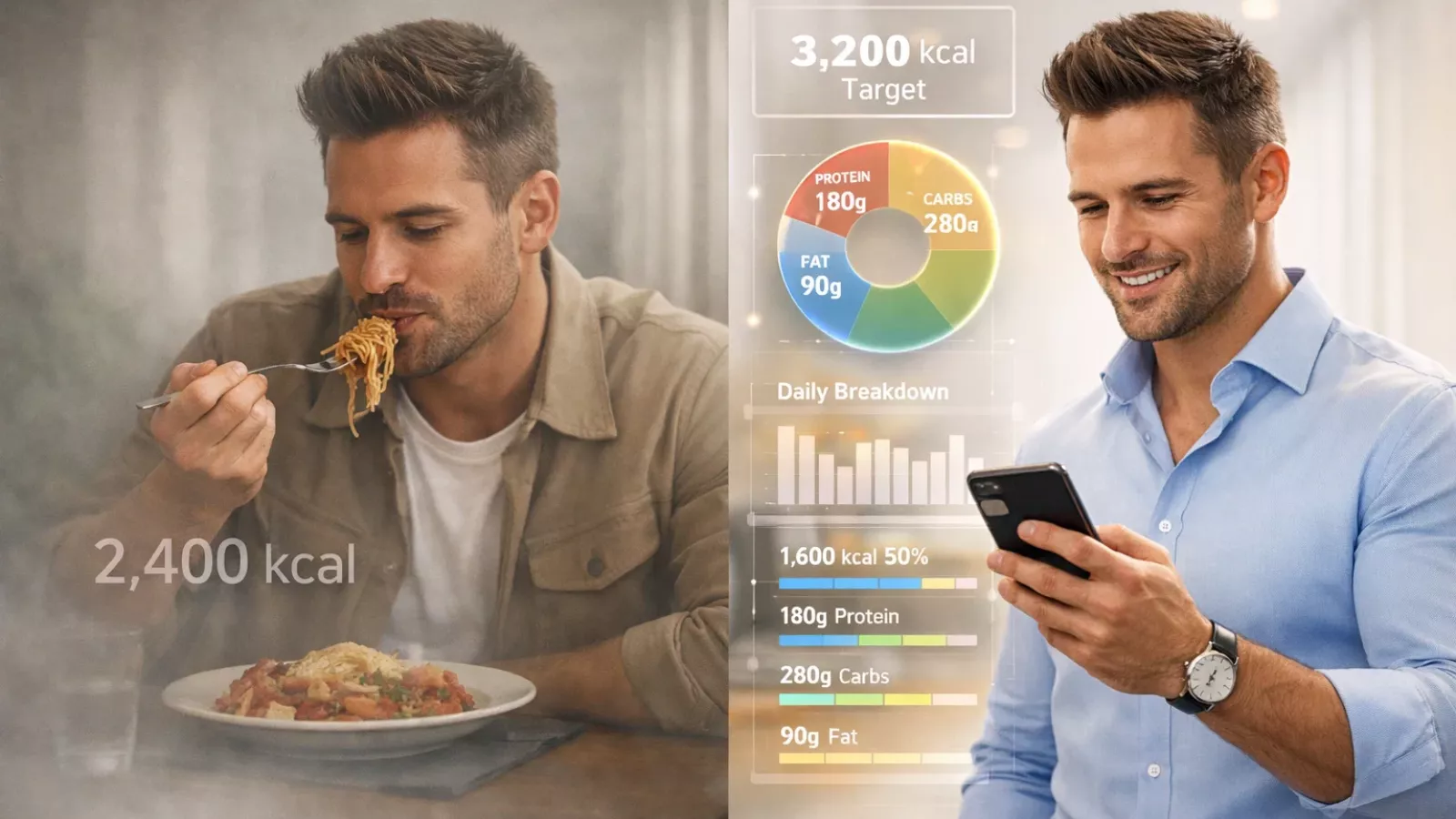
Let me tell you about a client I trained two years into my career. Built like a tank. Trained five days a week, never missed a session, and lifted heavy with great form. But after eight months of working together, his measurements had barely changed—something that can quietly stall your summer body prep without you even realizing it.
When I asked him to track his food for just one week, the picture became immediately clear. He was eating around 2,400 calories a day while his body needed closer to 3,200 to actually grow. He felt full; he felt like he was eating a lot, but the numbers told a completely different story.
That is the thing about bodybuilding. Your body does not care how hard you train if you are not fueling it correctly. Muscle growth is an energy-expensive process. Your body needs a caloric surplus to build new tissue, and it needs the right balance of macronutrients to make sure that surplus goes toward muscle rather than fat.
Without a proper bodybuilding calorie counter, you are essentially driving blind. I have seen this pattern repeat itself more times than I can count, and every single time, introducing a reliable calorie calculator for bodybuilding is what finally moved the needle.
Understanding Your Calorie Needs for Bodybuilding
Before you pick up any app or tool, you need to understand the numbers you are working toward. Here is how I explain it to my clients when they are setting up their bodybuilding calorie counter for the first time.
Step 1: Find Your Maintenance Calories
Your maintenance calories are the number of calories your body needs to stay exactly where it is, with no weight gain and no weight loss. This is calculated using your Total Daily Energy Expenditure, which accounts for your basal metabolic rate (the calories your body burns at rest) and your activity level.
A solid starting formula is the Mifflin-St Jeor equation:
For men: (10 x weight in kg) + (6.25 x height in cm) – (5 x age) + 5
Then multiply by your activity factor:
- Sedentary (desk job, minimal movement): 1.2
- Lightly active (1-3 days of training): 1.375
- Moderately active (3-5 days of training): 1.55
- Very active (6-7 days of hard training): 1.725
Run these numbers through any calories calculator for bodybuilding, and you will have your baseline to work from.
Step 2: Add Your Surplus for Bulking
Once you have your maintenance number, add 250 to 500 calories on top for a lean bulk. I always recommend starting at the lower end. A 500-calorie surplus done consistently will build muscle without piling on unnecessary fat. Anything beyond that and you are usually just gaining fat, which you will have to cut later anyway.
This is where a good bodybuilding calorie counter earns its keep. These numbers are your starting point, but your body will respond differently, and you will need to adjust over time based on real data. No formula replaces consistent tracking with an accurate calorie calculator for bodybuilding.
Macros Matter More Than Most People Realize
Calories get you in the right range. Macros determine what your body does with those calories. I cannot stress this enough with my clients, and it is the part most people skip when they first start using a bodybuilding calorie counter.
Here is the simple breakdown I give everyone:
Protein: The non-negotiable. Aim for 1.6 to 2.2 grams per kilogram of bodyweight. If you are in a serious bulk, staying toward the higher end protects muscle even if fat gain creeps in. For an 80 kg lifter, that is 128 to 176 grams of protein daily.
Carbohydrates: Your training fuel. Carbs power your workouts and replenish muscle glycogen after sessions. On a bulk, carbs should make up the majority of your remaining calories after protein is accounted for. Do not be afraid of carbs. They are your friend in this phase.
Fats: Essential for hormone production, including testosterone, which is obviously critical for muscle building. Keep fats at around 20 to 30 percent of your total calories. Do not drop them below 20 percent, or your hormonal health will take a hit.
A proper macro counter for bodybuilding tracks all three of these in real time, so you always know where you stand before the day is done, rather than finding out at 10 pm that you are 60 grams of protein short. The best bodybuilding calorie counter apps combine macro tracking and calorie tracking in one seamless dashboard, so nothing slips through the cracks.

The Best Bodybuilding Calorie Counter Tool In 2026
Now we get to the practical part. There are dozens of apps out there, and honestly, most of them are fine for casual use. But bodybuilding has specific demands, and the bodybuilding calorie counter you use should match that level of seriousness.
Here is what I recommend and why.
Calorie Tracker Buddy: The Bodybuilding Calorie Counter I Recommend to Almost Every Client
 I started recommending Calorie Tracker Buddy to my clients about a year ago, and the feedback has been overwhelmingly positive, especially from clients who have tried and abandoned other tracking apps in the past.
The reason is simple. The biggest problem with tracking is not knowing what to track. It is staying consistent long enough for it to actually matter. As a bodybuilding calorie counter, Calorie Tracker Buddy was built around that reality, and it shows in every feature.
Here is what makes it genuinely different:
Snap the Meal: Point your camera at your food, tap once, and it is logged. For bodybuilders eating five or six meals a day, this is a game-changer. Manually searching and logging every chicken breast and cup of rice gets old fast. This removes that friction entirely.
Calorie Intake Tracker: You eat, it calculates. Get instant feedback on how each meal fits your daily targets so you always know if you are on track or need to adjust your next meal.
Calorie Burn Tracker: Every movement counts toward your total energy expenditure. From your training session to walking between sets, the burn tracker gives you a complete picture of your output so your surplus calculations stay accurate.
Goal Predictions: This is the feature my bulking clients love most. It shows you in real time exactly how your current eating patterns are trending toward your goal. If you are consistently falling short of your surplus, you can see it and correct it before another week slips by.
Buddy Motivation: Your virtual pet grows with every healthy choice you make. It sounds simple, but gamification works. On the days when motivation dips and the idea of logging feels like one more task, the Buddy feature provides that small emotional nudge to stay consistent.
Social Sharing: Post your meals, share your progress, and let your gym community hold you accountable. When the people around you know what you are eating, the accountability multiplies significantly.
For bodybuilders who want a bodybuilding calorie counter that is accurate, fast to use, and genuinely motivating to stick with, Calorie Tracker Buddy is where I send people first.
Also Read
How to Track Macros for Beginners
Summer Body Prep: Your Complete Guide To Getting Lean and Feeling Confident
Common Mistakes I See Bodybuilders Make With Calorie Tracking
After six years of coaching, I have seen the same tracking mistakes repeat themselves over and over. These are the big ones to avoid, regardless of which bodybuilding calorie counter you are using.
Eyeballing portion sizes. This is the number one offender. A “handful” of almonds to one person is 150 calories. To another, it could be more. Weigh your food, at least until you have a genuinely calibrated sense of portions.
Not tracking cooking oils and sauces. A tablespoon of olive oil is 120 calories. If you are cooking with it three times a day and not logging it, you are missing 360 calories. That adds up fast and can throw your surplus calculations completely off.
Logging inconsistently. Tracking Monday through Friday and guessing on weekends is not tracking. Weekends are often where calorie intake shifts dramatically. If your data has gaps, your conclusions will be wrong.
Not adjusting targets over time. As you gain weight, your maintenance calories go up. A calorie target that created a surplus at 75kg might be maintenance at 82kg. Revisit your numbers every four to six weeks and adjust accordingly. Your calorie calculator for bodybuilding is only as useful as the frequency with which you update your inputs.
Trusting app’s calorie burns blindly. Wearables and apps overestimate calorie burn regularly. I tell my clients to treat burn data as directional information rather than exact numbers. Build your surplus from food targets rather than eating back every calorie your watch tells you that you burned.
How To Actually Start Tracking Today
Here is the simple process I give new clients who have never used a bodybuilding calorie counter before.
First, calculate your maintenance calories using the formula above. Then add 300 calories as your starting surplus. Do not jump straight to 500 until you see how your body responds.
Second, set your protein target first. Hit that number every single day without exception. Then fill your remaining calories with carbs and fats in a ratio that feels sustainable and supports your training energy.
Third, pick a tracking tool and use it for at least four weeks before judging whether it is working. Consistency in tracking is what produces useful data, and useful data is what lets you make smart adjustments. A bodybuilding calorie counter only works if you actually open it every day.
Fourth, weigh yourself every morning under the same conditions (after using the bathroom, before eating) and take a weekly average. Bodyweight fluctuates daily, so daily numbers are noisy. Weekly averages show the real trend.
If you are gaining more than 0.5 to 1 percent of your bodyweight per month, pull back the surplus slightly. If you are gaining nothing after three weeks of consistent tracking, increase calories by 150 to 200 per day and monitor again.
Final Word From the Gym Floor
Six years of coaching has taught me that training is actually the easier part of bodybuilding. Most people will show up and do the work if they are motivated enough. What separates the people who transform their physiques from the ones who stay stuck for years is almost always nutrition, and specifically, whether they actually know what they are eating.
A good bodybuilding calorie counter does not do the work for you. But it gives you the information you need to make better decisions every single day. And in bodybuilding, better decisions compounded over months and years is what builds an exceptional physique.
FAQs
How does a calorie calculator bodybuilding tool work?
A calorie calculator bodybuilding tool estimates your daily calorie needs based on weight, height, age, and activity level. It gives you a baseline to plan bulking or cutting.
Is a calories calculator for bodybuilding accurate for bulking?
A calories calculator for bodybuilding provides a strong starting point, but adjustments are needed based on real progress. Consistent tracking improves its accuracy over time.
Why is a macro counter bodybuilding important?
A macro counter bodybuilding tracks protein, carbs, and fats to ensure your calories support muscle growth. It helps you hit precise nutrition targets daily.