


Let me be straight with you from the start.
I have been training clients for six years, and the number one reason people fail to build muscle is not a lack of effort in the gym. It is a lack of understanding about what actually drives muscle growth outside of it. I have worked with college students in Delhi who train twice a day but live on maggi and chai. I have coached IT professionals in Bangalore who hit the gym religiously after work but undereat protein because they assume their dal chawal is enough. I have trained young guys in Mumbai who spend thousands on whey protein but have no idea what their actual daily calorie intake looks like.
The effort is always there. The structure rarely is.
The answer, almost every single time, comes down to two things: how you train and how you eat. Get both right and muscle gain becomes almost inevitable. Get one wrong and you are spinning your wheels no matter how many sets you put in.
This is the complete guide. Training principles, nutrition strategy, the best Indian foods for muscle building, a practical desi diet plan, and the tools that make it all stick.
Listen To The P0dcast Now!
Understanding How Muscle Growth Actually Works
 Before we talk about what to do, it helps to understand what is actually happening inside your body when you build muscle.
Your skeletal muscles are made up of parallel cylindrical fibers. Your body is constantly breaking down and rebuilding the protein molecules within those fibers. When you remove more protein than you deposit, you lose muscle. Also when the balance is even, nothing changes. When you deposit more protein than you remove, your muscles grow.
That process of increasing muscle mass is called muscle hypertrophy, and it is the primary goal of resistance training. Hormones like testosterone and growth hormone drive the process, but they can only do their job when you supply the right raw materials: sufficient protein, adequate calories, and consistent mechanical stress on the muscle through training.
Here is the part most people miss. Training is the stimulus. Nutrition is the response mechanism. You cannot have one without the other and expect results. Lifting hard without eating right is like revving a Royal Enfield with no fuel in the tank. The machine is capable. The input is missing.
How To Gain Muscle: The Training Foundations
Choose the Right Rep Range
The repetition range you train in determines the primary adaptation your body makes. Here is the simple framework I use with every client when they ask how to gain muscle through training structure:
Training with weights you can only lift for 1 to 5 reps builds primarily strength. With weight training, you can lift for 8 to 12 reps builds the most muscle. Training with weights you can lift for 15 or more reps develops muscular endurance.
For muscle gain, the 8 to 12 rep range is your primary zone. That said, different people respond differently, and cycling through rep ranges over weeks and months produces better long-term results than staying in one range forever.
Pick the Right Weight
The weight needs to be challenging enough that by the final rep of your set, you are at or very close to failure. If you could easily do three more reps after finishing your set, the weight is too light to drive meaningful muscle growth. You should never have more than two reps left in the tank at the end of a working set.
Structure Your Workouts Around Compound and Isolation Movements
Compound movements like squats, deadlifts, bench press, rows, and overhead press engage multiple large muscle groups simultaneously. They are the foundation of any effective muscle-building programme because they produce the greatest hormonal response and the most functional strength.
Isolation movements like bicep curls, tricep extensions, and lateral raises target specific muscles and are excellent for addressing weak points or adding volume at the end of a session when you are too fatigued for more compound work.
A solid structure to follow is three sets of three to five compound movements followed by three sets of one to two isolation movements per session. Keep total exercises between five and seven to avoid overtraining and allow adequate recovery between sessions.
Muscle Gain Diet Plan: What to Eat and How Much
Training is only half of the equation. The muscle gain diet plan you follow determines whether that training produces actual tissue growth or simply fatigue.
Calories: The Foundation
To build muscle, you need to eat more calories than your body burns. But there is a ceiling to how fast muscle can actually be built. Research suggests that realistic maximum muscle gain in adult males sits at 0.25 to 0.9 kilograms per month under optimal conditions. Beyond that rate, excess calories are stored as fat rather than converted to muscle.
The sweet spot is a surplus of 300 to 500 calories above your total daily energy expenditure. This is enough to fuel muscle growth without accumulating significant body fat alongside it.
To find your surplus starting point, estimate your total daily energy expenditure using an online calculator, then add 300 calories as your daily target. After two to three weeks, assess your weight trend. If you are gaining nothing, add another 100 to 150 calories. If you are gaining more than one percent of your bodyweight per week, pull back slightly.
One important note for the Indian context: many of my clients significantly underestimate how many calories their typical Indian meals contain, especially when ghee, oil, and coconut milk are involved in cooking. Always account for cooking fats. They add up faster than you think.
Protein: The Non-Negotiable
For muscle gain, protein is the single most important dietary variable. Research consistently supports a target of 1.4 to 2 grams of protein per kilogram of bodyweight daily for those training to build muscle. For a 70kg person, that is 98 to 140 grams of protein every single day.
This is where most Indians, vegetarian or not, fall short. A typical Indian vegetarian diet built around roti, rice, sabzi, and dal often delivers 40 to 60 grams of protein daily at best. That is less than half of what a training individual actually needs. It is not that Indian food is bad. It is that the protein portions need to be deliberately and significantly increased.
Spread that protein across four to six meals rather than concentrating it in one or two sittings. Your body can only use so much protein for muscle synthesis at one time, and distribution throughout the day optimises the anabolic response from each meal.
Carbohydrates: Your Training Fuel
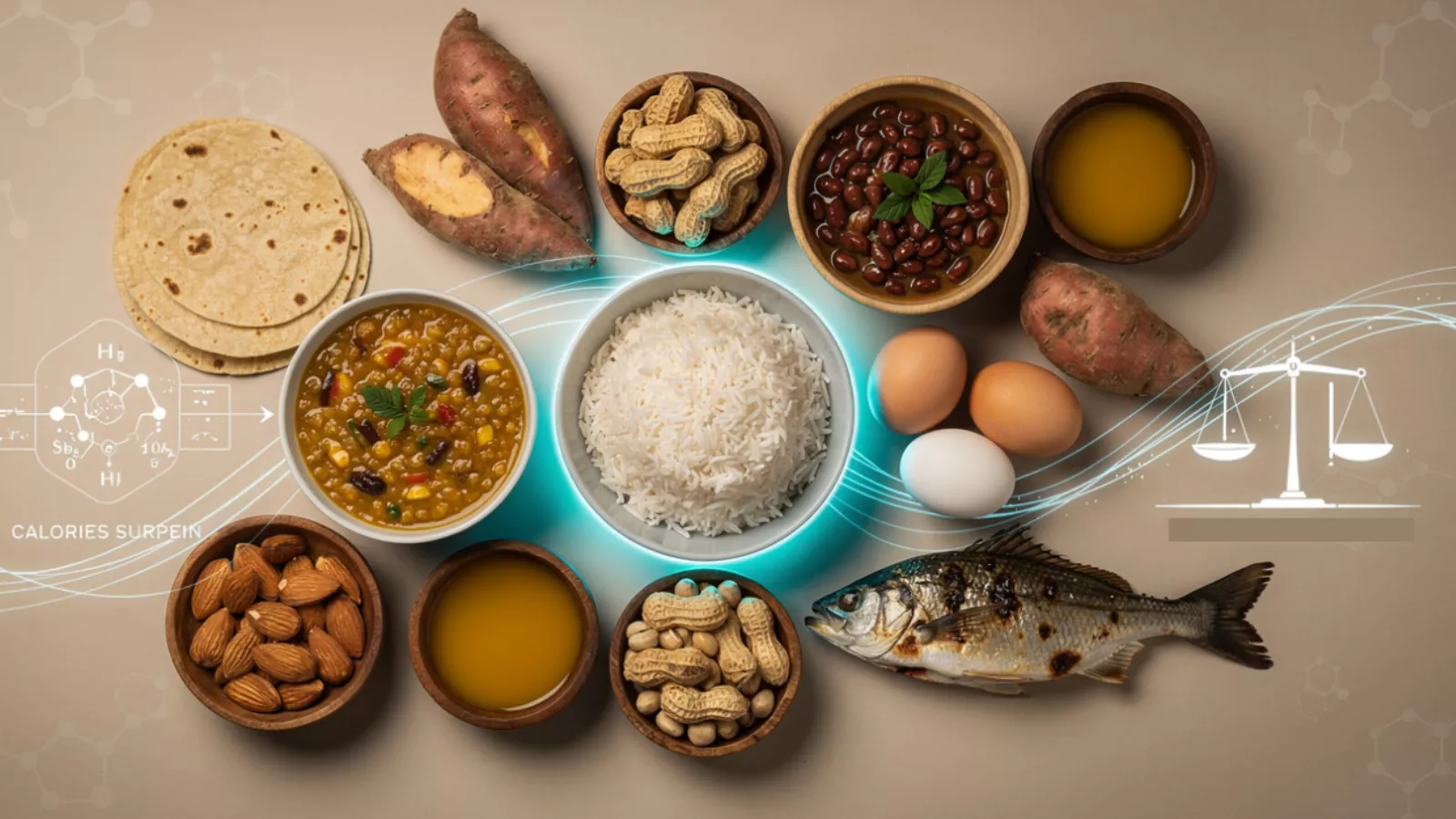
Good news for Indian eaters: our cuisine is naturally rich in complex carbohydrates. Rice, roti, poha, oats, sweet potato, and rajma all provide the glycogen your muscles need to train hard and recover well. Carbohydrates are stored in your muscles as glycogen and are the primary fuel source for intense resistance training.
On a muscle gain diet plan, carbohydrates should make up the bulk of your calories after protein targets are met. The typical Indian plate is already well-structured for carbohydrate intake. The issue is usually protein, not carbs.
Fats: Essential, Not Optional
Dietary fat is critical for hormone production, including testosterone, which is the primary anabolic hormone driving muscle growth. Indian cooking already uses healthy fats through ghee, mustard oil, coconut oil, and peanuts. These are genuinely useful in a muscle gain context as long as portions are tracked.
Aim for 0.5 to 1.5 grams of fat per kilogram of bodyweight daily, prioritising sources like ghee in moderation, peanuts, almonds, eggs, and fatty fish like rohu and surmai.
Best Protein Food for Muscle Gain: The Indian Edition
The quality of your protein sources matters alongside the quantity. Here are the best protein food for muscle gain options tailored specifically to Indian eating patterns and food availability.
Eggs:
The most affordable and complete protein source available across India. One large egg provides 6 grams of complete protein with all nine essential amino acids. Whole eggs outperform egg whites for building lean muscle. Anda bhurji, boiled eggs, omelettes, and egg curries all count. Eat them daily and eat them whole.
Paneer:
The go-to protein source for Indian vegetarians, and a genuinely excellent one. 100 grams of paneer provides approximately 18 to 20 grams of protein alongside calcium and healthy fats. Grilled paneer, paneer bhurji, and paneer tikka are high-protein meal options that fit naturally into a desi eating pattern.
Chicken:
Chicken breast remains one of the most protein-dense, versatile foods available. 100 grams delivers 22 grams of complete protein with minimal fat. Tandoori chicken, chicken curry with minimal oil, and boiled chicken are all excellent options that work well in an Indian kitchen.
Soya chunks (Nutrela):
Perhaps the most underrated muscle-building food in the Indian market. 100 grams of dry soya chunks contains approximately 52 grams of protein, making it one of the highest protein-per-rupee foods available anywhere. Soya chunk curry, soya bhurji, and soya pulao are all practical everyday options.
Greek yogurt and curd:
Thick curd and Greek-style yogurt provide protein alongside probiotics that support gut health and nutrient absorption. Choose full-fat or low-fat options over no-fat, which often has added sugar. A large bowl of hung curd or Greek yogurt delivers 15 to 17 grams of protein.
Fish:
Rohu, katla, surmai, and bangda are widely available across India and provide excellent high-quality protein alongside omega-3 fatty acids that reduce inflammation and support recovery. Fish curry with minimal oil, grilled fish, and fish tikka are all great options.
Peanuts and peanut butter:
Affordable, widely available, and surprisingly protein-dense at 7 grams per ounce. A spoon of peanut butter in a smoothie or as a roti spread is an easy way to add protein to any meal.
Milk:
Full cream or toned milk is an excellent protein source that most Indians already consume daily. Two glasses of milk provide approximately 16 grams of protein alongside calcium and vitamin D. Homemade protein shakes with milk, banana, and peanut butter are a cost-effective alternative to expensive commercial supplements.
Also Read
The Ultimate 5 Day Gym Routine For Strength And Muscle Gain
Track Your Muscle Gain Diet With Calorie Tracker Buddy
 Here is something I tell every client who is serious about muscle gain: the knowledge is the easy part. Executing it consistently, every single day, across weeks and months of training, is where most people come unstuck.
You can know your protein target. You can know your calorie surplus. But without actually tracking what you eat, you will consistently fall short or accidentally overshoot without ever knowing which one is holding you back. This is especially true in the Indian context where home-cooked food, restaurant meals, and street food make portion estimation genuinely difficult.
This is exactly why I recommend Calorie Tracker Buddy as the tracking tool of choice for anyone following a serious diet plan for muscle gain.
Snap the Meal: Point your camera at your dal chawal, paneer sabzi, or chicken curry, tap once, and your meal is logged instantly with full calorie and macro breakdown. No manual searching, no guessing. For someone eating four to six protein-focused meals daily, this feature alone is the difference between a tracking habit that lasts and one that fades by week two.
Calorie Intake Tracker: Get instant feedback on how each meal is contributing to your daily calorie surplus and protein targets. You always know exactly where you stand before the day ends, so you can top up protein with a quick paneer snack or egg whites if needed.
Calorie Burn Tracker: On heavy training days your calorie needs shift significantly. The burn tracker accounts for your full daily energy output, keeping your surplus calculations accurate and ensuring you are eating enough to fuel growth.
Goal Predictions: See in real time how your current eating trajectory is trending toward your muscle gain goals. If your protein is consistently falling short or your surplus is too aggressive, you catch it immediately and correct before another week passes without progress.
Buddy Motivation: Your virtual pet grows with every healthy choice you make. On the days when dal rice feels repetitive and meal prep motivation is low, the Buddy feature provides that small but real nudge to stay consistent.
Social Sharing: Share your meals, celebrate your progress, and build accountability within your gym community or friend group. Consistency in nutrition improves dramatically when other people are paying attention alongside you.
A 5-Day Indian Diet Plan for Muscle Gain
Here is a practical sample week built around approximately 2,800 to 3,000 calories and 140 to 150 grams of protein daily for a 70 to 75kg individual in a lean bulk, using realistic Indian foods.
Day 1 Breakfast: Four eggs bhurji with two whole wheat rotis and a glass of milk. Mid-morning snack: One bowl Greek yogurt with a banana and a handful of roasted peanuts. Lunch: Two katoris of rajma with two rotis, one bowl brown rice, and cucumber salad. Pre-training snack: Roasted chana with a glass of milk. Dinner: Grilled chicken (150 grams) with one bowl dal and two rotis. Post-training: Homemade protein shake with milk, banana, and peanut butter.
Day 2 Breakfast: Moong dal cheela (three pieces) with curd and a glass of milk. Mid-morning snack: Boiled eggs (three) with roasted peanuts. Lunch: Chicken curry (150 grams) with brown rice and salad. Pre-training snack: Soya chunk bhurji with one roti. Dinner: Paneer tikka (150 grams) with dal tadka and two rotis.
Day 3 Breakfast: Oats with milk, banana, and almonds alongside two boiled eggs. Mid-morning snack: Hung curd with roasted chana. Lunch: Fish curry (surmai or rohu, 150 grams) with rice and sabzi. Pre-training snack: Peanut butter roti with a glass of milk. Dinner: Soya chunk curry with two rotis and mixed vegetable sabzi.
Day 4 Breakfast: Four egg omelette with vegetables and two whole wheat rotis. Mid-morning snack: Greek yogurt with mixed nuts and honey. Lunch: Chole with two rotis and a bowl of rice alongside raita. Pre-training snack: Paneer cubes (100 grams) with roasted peanuts. Dinner: Grilled chicken breast with dal and brown rice.
Day 5 Breakfast: Poha with peanuts, sprouts mixed in, alongside a three-egg omelette. Mid-morning snack: Milk with banana and peanut butter smoothie. Lunch: Rajma rice with a side of paneer sabzi. Pre-training snack: Roasted soya chunks with chai. Dinner: Fish tikka with dal makhani in moderation and two rotis.
Foods to Limit When Building Muscle
A solid muscle gain diet plan is not just about what you eat. It is about what you minimise. These foods actively work against your muscle-building goals in the Indian context:
Excessive maida-based foods like white bread, biscuits, and fried snacks like samosas and pakoras provide empty calories without nutritional value. Too much chai with sugar throughout the day adds hidden calories without protein. Alcohol impairs protein synthesis and disrupts sleep quality, both of which are critical for recovery. Packaged namkeen and chips are calorie-dense without the protein content needed to support muscle growth. Overreliance on white rice with very little protein on the plate is the most common nutritional pattern I see holding Indian clients back.
None of these need to be permanently eliminated. But they should be exceptions rather than daily staples.

FAQs
Q1. Can vegetarians build muscle effectively on an Indian diet?
Absolutely yes, but it requires deliberate planning. Vegetarian Indians need to significantly increase their intake of paneer, soya chunks, Greek yogurt, chana, dal, and milk to hit protein targets. The food culture supports it, but the portions need to be much larger than the typical Indian vegetarian plate.
Q2. Is whey protein necessary for muscle gain in India?
No. Whey protein is convenient but not essential. Whole food sources like eggs, paneer, soya chunks, chicken, and dal can fully meet protein requirements. If budget is a concern, prioritise real food first and consider whey only as a supplement to bridge gaps.
Q3. How many rotis should I eat on a muscle gain diet plan?
This depends entirely on your total calorie target. Three to five rotis per day is a reasonable range for most people in a lean bulk, paired with adequate protein at each meal. Do not fear rotis. Fear of inadequate protein alongside them.