


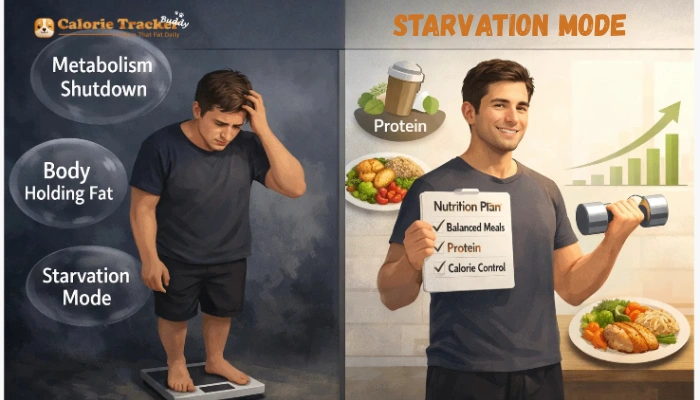
You’ve been eating less. You’ve been moving more. And yet the scale hasn’t budged in weeks. Someone in your life or a fitness forum you stumbled upon at midnight tells you: “You’re probably in starvation mode.”
And just like that, starvation mode becomes the villain of your weight loss story.
But here’s the thing: while metabolic adaptation is a real physiological response, it is very rarely the actual reason your weight loss has plateaued. Blaming it without examining the full picture can keep you stuck, frustrated, and making the wrong changes for months.
This blog is going to give you an honest, balanced breakdown of what starvation mode actually is, what the real signs are, why it’s unlikely to be your problem, and what is genuinely holding your progress back.
In a hurry? Listen to the blog instead!
What Is Starvation Mode And Why Does Everyone Blame It?
Starvation mode scientifically called metabolic adaptation, is the body’s survival response to prolonged, severe calorie restriction. When your body senses that it isn’t receiving enough energy for an extended period, it begins to slow down its metabolic rate to conserve fuel. It reduces energy output, holds onto fat stores, breaks down muscle tissue, and downregulates key hormones like leptin and thyroid hormones.
This is a real, well-documented biological process. No one is disputing that.
The problem is the way the term has been used in popular diet culture. Over time, starvation mode became a catch-all explanation for every weight loss plateau, every slow week, and every frustrating moment where results didn’t match effort. People started believing that eating too little, even for a few days, would completely shut down fat burning and cause the body to hoard calories.
That interpretation is where the myth lives not in the science.
Is Starvation Mode Real? Yes, But Not The Way You Think
So is starvation mode real? Absolutely. But it works very differently from what most people imagine.
True metabolic adaptation from starvation mode requires weeks to months of severely inadequate calorie intake, not a few days of eating light, maintaining a moderate calorie deficit, or skipping a single meal.
The Minnesota Starvation Experiment, one of the most referenced studies on this topic, involved men eating around 1,500 calories a day for 24 weeks under controlled conditions. Only after months of sustained restriction did significant metabolic slowdown occur.
For the average person on a weight loss diet, eating 1,200 to 1,500 calories a day is not going to trigger full-blown starvation mode in a matter of weeks. Your metabolism will adapt slightly that’s normal but it will not grind to a halt and start storing every calorie as fat.
What research does show is that metabolic adaptation is real but modest in most dieting scenarios, typically accounting for a reduction of around 100 to 300 calories per day in metabolic rate. That reduction is meaningful, but it is not the dramatic metabolic shutdown people often imagine when they blame a weight loss plateau on the body entering a protective conservation state
The Real Signs Of Starvation Mode
It helps to understand the difference between a normal weight loss plateau and true starvation mode. Below are the key signs explained clearly and simply:
Persistent weight loss plateau despite very low calorie intake:
If you consistently consume a measurably low number of calories for many weeks and your weight refuses to move at all, this may signal metabolic adaptation beyond a normal slowdown.
Deep, chronic fatigue:
This is not ordinary tiredness. It feels like constant exhaustion that does not improve even after proper sleep or rest days.
Feeling unusually cold:
If you frequently feel cold, even in warm environments, it may indicate that your body is conserving energy by lowering metabolic output.
Noticeable hair thinning:
Inadequate long-term nutrition can cause the body to redirect nutrients away from non-essential functions like hair growth.
Irregular or missed menstrual cycles (in women):
Hormonal disruption is common when the body perceives prolonged energy deficiency. This is a significant physiological warning sign.
Significant drop in libido:
When energy availability remains low, the body reduces reproductive drive as a protective survival response.
Loss of muscle mass:
If muscle decreases alongside a weight plateau, it may indicate prolonged insufficient nutrition rather than a simple fat loss stall.
These signs of starvation mode develop gradually over an extended period of truly inadequate calorie intake. They do not appear after just one week in a calorie deficit. If you feel reasonably energetic, maintain normal body temperature, and do not experience hair loss or hormonal disruption, a short-term plateau is likely normal metabolic fluctuation rather than starvation mode.
Also Read:
How To Track Calories While Living In A Dorm Or Hostel
So What Is Actually Stopping Your Weight Loss?
This is the part that matters most. If starvation mode isn’t the real culprit, what is? The honest answer: one or more of the following very common, very fixable issues.
You’re Eating More Than You Think:
This is the number one reason weight loss stalls, and it’s not an accusation it’s human nature. Studies consistently show that people underestimate their calorie intake by 20 to 50 percent. A splash of olive oil here, a handful of nuts there, a sauce you didn’t account for it adds up faster than anyone expects.
Without accurate, consistent tracking, it’s almost impossible to know whether you’re genuinely eating at a deficit or just feeling like you are. Starvation mode gets the blame, but the real issue is invisible extra calories.
Your Calorie Needs Have Changed:
As you lose weight, your body requires fewer calories to function. A 180-pound person burns more calories at rest than a 150-pound person. If you’ve lost weight but haven’t adjusted your intake accordingly, what was once a deficit may now be maintenance. Your weight loss stops not because of starvation mode, but because of simple math.
You’re Moving Less Without Realizing It:
When you reduce calories, your body naturally reduces non-exercise activity the fidgeting, the spontaneous walks, the energy you put into everyday tasks. This is called non-exercise activity thermogenesis (NEAT), and it can drop significantly when you’re in a prolonged deficit. You burn fewer calories overall without changing your formal exercise routine, and the deficit quietly disappears.
You’re Retaining Water:
Hormonal fluctuations, high sodium intake, stress, poor sleep, and even intense exercise can all cause temporary water retention that shows up on the scale. Many people experience this as a “plateau” when fat loss is actually continuing underneath. The scale doesn’t always tell the full story.
You’ve Hit a True Adaptation Not Starvation Mode:
our metabolism does adapt to a calorie deficit over time this process is known as metabolic adaptation, and it is real. However, it is very different from the dramatic metabolic shutdown many people describe.
The solution is not to immediately start eating more. Instead, reassess your calorie deficit, ensure you are consuming enough protein, adjust or increase strength training to preserve muscle, and consider taking a short diet break at maintenance calories to help regulate hunger hormones and support long-term progress.
How Accurate Tracking Solves Most Of This?
The thread connecting almost all of these real causes of weight loss plateaus is a lack of accurate data. When you don’t know precisely what you’re eating, how much you’re burning, and how your body is responding day to day, you’re making decisions in the dark.
This is exactly where smart tools change the game,and it’s where an app like Calorie Tracker Buddy becomes genuinely valuable.
How Calorie Tracker Buddy Keeps You Out Of The Plateau Trap?

Calorie Tracker Buddy is built for exactly this problem. It gives you the accurate, real-time data you need to understand what’s actually happening with your calories so you stop guessing and start making decisions that work.
Snap the Meal:
Point your camera at your food, tap once, and your meal is instantly analyzed for calories, nutrients, and balance. This single feature eliminates the most common cause of weight loss plateaus underestimating what you eat. No more invisible calories slipping through the cracks.
Calorie Intake Tracker:
Track what’s on your plate in seconds and get instant feedback on how it fits your goals. Knowing your real numbers on a daily basis is the difference between a genuine deficit and one that exists only in your head.
Calorie Burn Tracker:
From workouts to everyday movement, every calorie burned gets counted. Tracking your burns alongside your intake gives you the complete picture of your energy balance and helps you spot when NEAT has dropped without you noticing.
Goal Predictions:
Calorie Tracker Buddy shows you exactly how each meal, snack, and sip impacts your progress. Instead of waiting weeks to realize something isn’t working, you get ongoing feedback that lets you course-correct in real time.
Buddy Motivation:
Your virtual pet grows with every healthy choice you make. It’s a small but surprisingly powerful feature that turns consistency into something enjoyable because the biggest obstacle to long-term results is simply staying the course.
Social Sharing:
Share your meals, post your streaks, and let your community cheer you on. Accountability is one of the most underrated drivers of sustained weight loss progress, especially when you consistently track calories and stay aware of your daily habits.
With Calorie Tracker Buddy, you replace guesswork with clarity and clarity is what breaks plateaus. Download it on Google Play or the App Store and give your weight loss journey the data it deserves.

When Should You Actually Worry About Starvation Mode?
To keep this balanced: there are situations where severe metabolic adaptation becomes a legitimate concern. If you have been eating below 1,000 calories per day for several months, if you are experiencing multiple warning signs of prolonged energy deficiency at the same time, or if you have lost significant muscle mass alongside a complete weight loss stall, then metabolic slowdown may genuinely be a factor worth addressing with a healthcare professional or registered dietitian.
In these cases, a structured reverse diet gradually increasing calories over several weeks can help restore metabolic rate, rebuild muscle, and create a healthier foundation for sustainable fat loss going forward.
But these are edge cases. For the vast majority of people who believe starvation mode is ruining their diet, the real answer is better tracking, smarter deficit management, and more consistency.
The Takeaway
Starvation mode is real but it is not the weight loss villain it’s been made out to be. For most people, the plateau they’re experiencing has nothing to do with their metabolism shutting down and everything to do with calorie estimation errors, natural metabolic adaptation, NEAT reduction, or water retention.
Understanding the genuine signs of starvation mode helps you recognize whether you actually have a problem or whether you just need better data and a recalibrated approach.
Stop blaming starvation mode for what is almost certainly a tracking and consistency issue. Arm yourself with accurate information, use smart tools like Calorie Tracker Buddy to stay on top of your intake and burns, and give your body the informed, patient approach it deserves.
Your weight loss isn’t stalled because your body is working against you. It’s stalled because something in your approach needs a small, data-driven adjustment. Find that adjustment and keep going.