


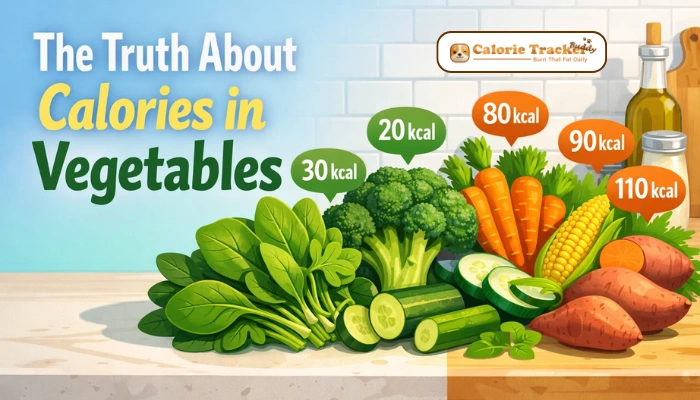
Ask ten people on a diet whether they track their vegetable intake, and you will get ten different answers. Some log every gram of spinach with meticulous precision. Others treat all vegetables as a free pass, eating as many as they want, and they do not count. The reality, as with most things in nutrition, lies somewhere in the middle. Understanding the calories in vegetables properly, rather than just accepting that they are “low calorie” as a vague notion, makes it much easier to decide when tracking them matters and when it is just adding unnecessary friction to an already demanding habit.
This guide covers everything you need to know, including a full calorie comparison table, common tracking mistakes, and a clear framework for when to log and when to let it go.
🎧 Listen To The Blog:
How Many Calories Are In Vegetables, Really?
The short answer: far fewer than almost any other food category, which is why calories in vegetables occupy such a central place in virtually every mainstream diet approach. But “low calorie” covers a meaningful range, and knowing that range is useful.
Most non-starchy vegetables sit between 15 and 50 calories per 100 grams. That’s a small number relative to their volume and weight gain, which is why a large bowl of salad greens or a generous serving of broccoli barely registers in a daily calorie budget. For context, 100 grams of chicken breast is around 165 calories; 100 grams of white rice is around 130. The same weight of a cucumber is 15 calories.
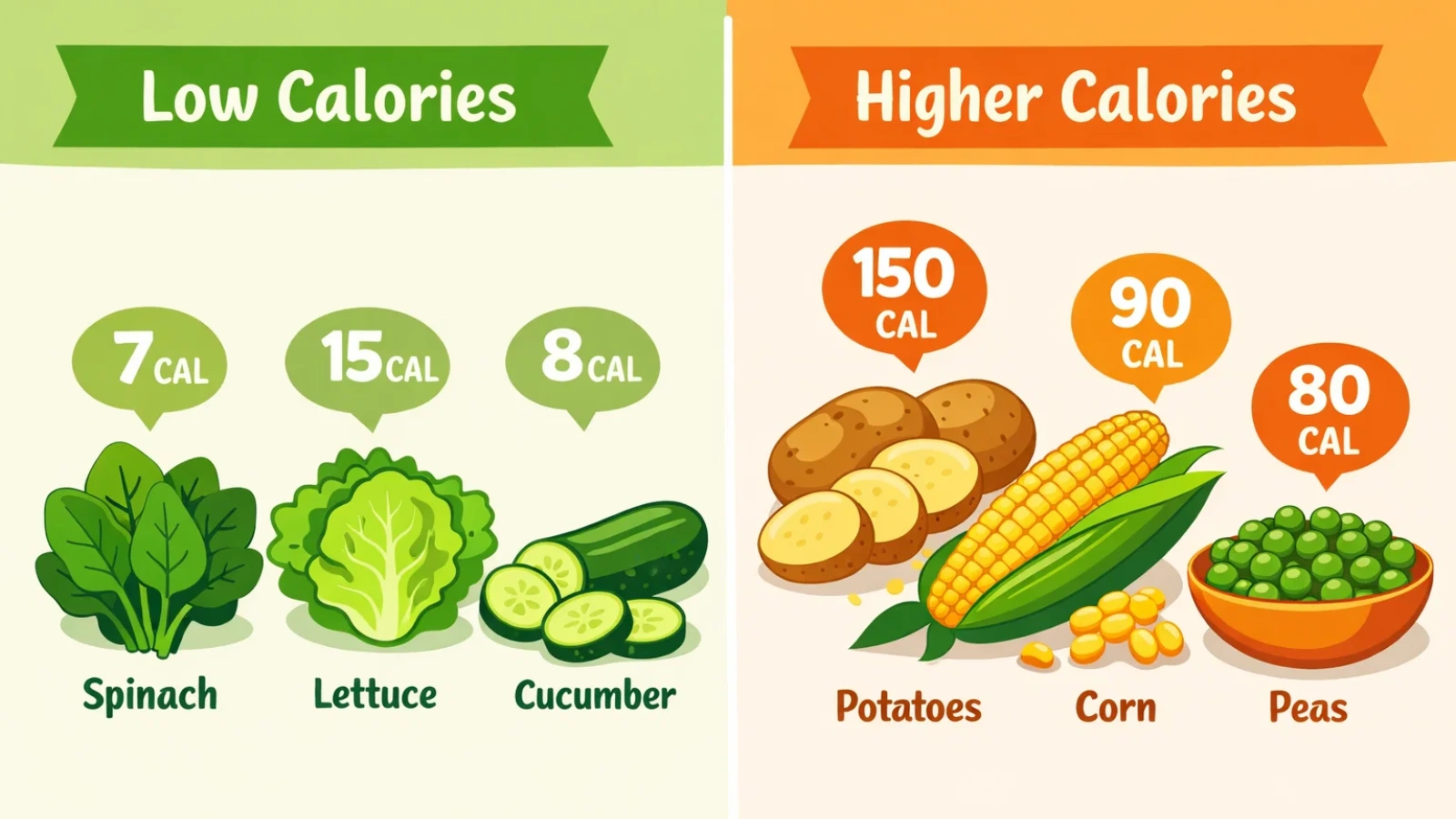
The low calorie count in most vegetables comes from their high water content and significant fiber. Water and fiber add weight and volume without contributing meaningful energy. A cup of raw spinach weighs around 30 grams and contains roughly 7 calories, less than a single mint.
Vegetables also contain carbohydrates, protein, and small amounts of fat, along with vitamins, minerals, and phytonutrients. The carbs are primarily fiber in most non-starchy varieties, which is partly why the net calorie impact is so small. Starchy vegetables, potatoes, corn, peas, sand weet potato are a different story and are covered in the comparison section below.
Green Vegetables Calories: Are They Truly “Free”?
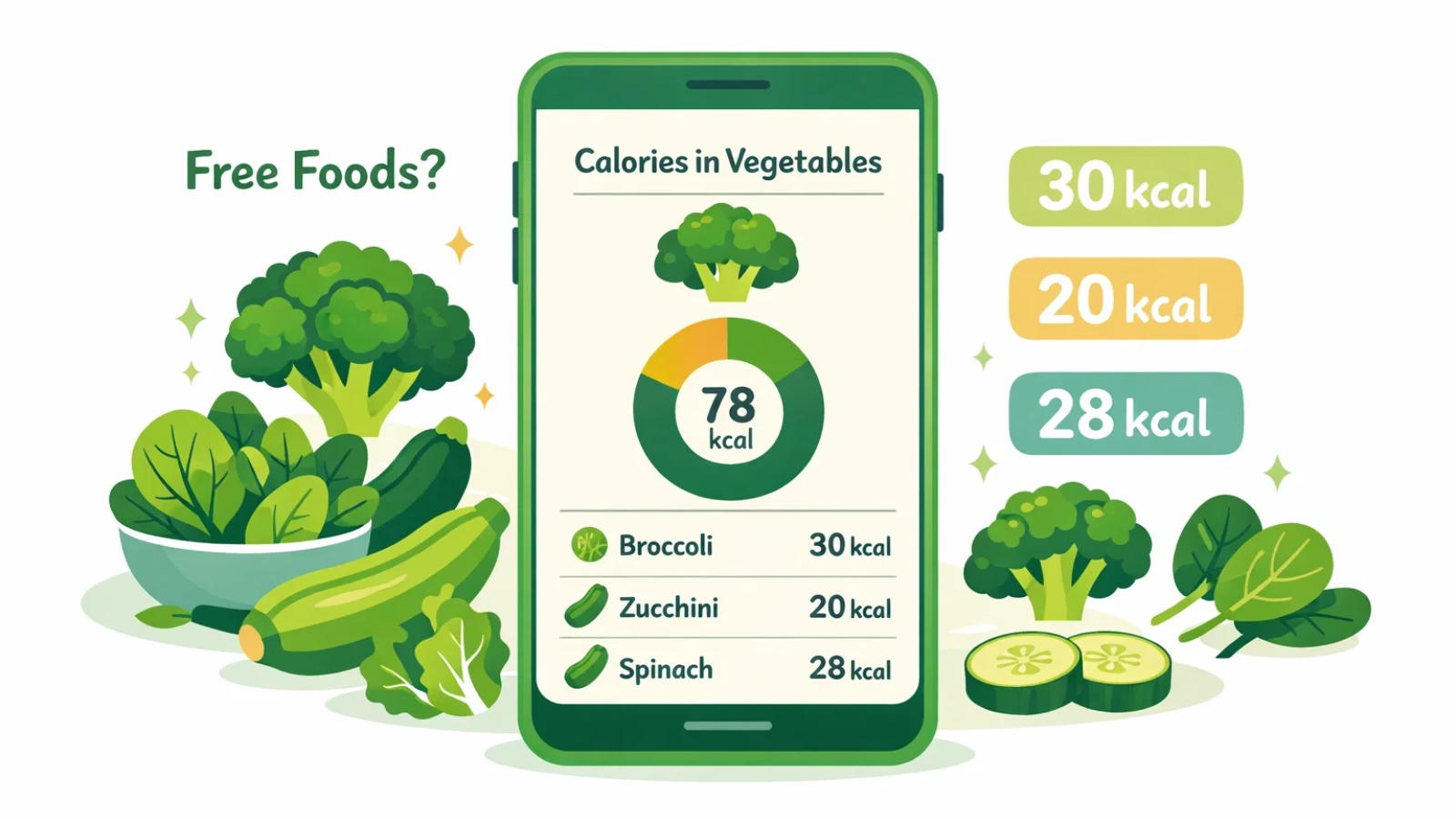
Green vegetables’ calories are, in practical terms, negligible for most people in most diets. Leafy greens like spinach, romaine lettuce, and kale clock in at 17 to 49 calories per 100 grams. Broccoli sits at around 34 calories per 100 grams. Zucchini and cucumber are both under 20 calories per 100 grams.
To put that in perspective: you would need to eat roughly 600 grams of raw spinach, an almost physically impractical amount, to consume 140 calories from it. The calories in leafy greens are so small relative to the volume required to eat them that, for the vast majority of people in the vast majority of diet contexts, they functionally don’t move the needle.
The idea of negative-calorie foods, the claim that some calories in vegetables require more energy to digest than they contain, is a myth worth dismissing briefly. No food has been demonstrated to produce a net negative calorie effect. Celery and cucumber are often cited as examples, but while they’re extremely low in calories, the digestive energy they require is far smaller than their calorie content. They’re just very low-calorie foods, which is genuinely useful without needing to be mythologized.
So are green vegetables truly “free”? Not technically, every food contains some energy. But practically, for most people following a general fat loss or maintenance diet, treating leafy greens and low-calorie green calories in vegetables as free is a reasonable and defensible simplification.

Vegetables Calories Comparison: Leafy vs Starchy vs Root
Here’s where the meaningful variation in vegetable calories lives. The difference between leafy greens and starchy vegetables isn’t a rounding error; it’s a five to six times difference in calorie density per 100 grams.
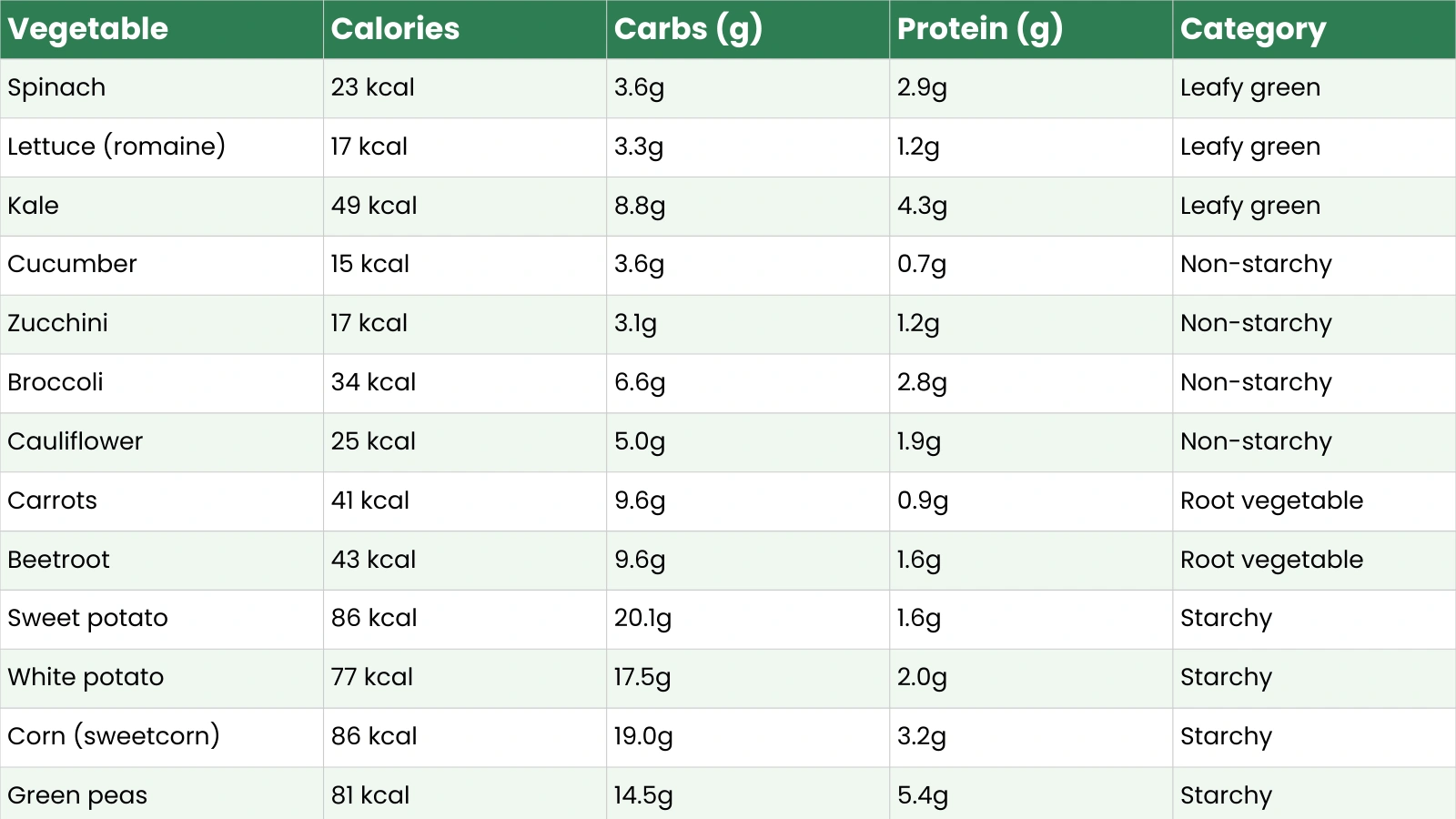
All figures are approximate for raw, uncooked vegetables. Cooking methods, particularly roasting with oil, frying, or adding butter, can significantly increase the calorie count of any vegetable on this list.
The key takeaway from this table is that starchy calories in vegetables behave nutritionally more like grains than like leafy greens. A 200-gram serving of boiled potato or sweetcorn contains roughly 150 to 170 calories, comparable to a portion of rice or pasta. This doesn’t make them unhealthy, but it does mean they shouldn’t be treated as interchangeable with leafy greens for calorie tracking purposes.
Read More:
Best Calorie Tracker Apps for Beginners in 2026
5 Signs You Need a Calorie Tracker App (Not Just a Spreadsheet)
Common Mistakes When Counting Vegetable Calories
Before getting into when to track and when not to, it’s worth understanding where vegetable calorie counts most commonly go wrong. The vegetables themselves are rarely the issue; it’s what gets added to them.
Not Counting Cooking Oils
A tablespoon of olive oil used to roast vegetables adds around 120 calories. If you’re roasting a full tray of broccoli, cauliflower, and sweet potato with two tablespoons of oil, you’ve added 240 calories that have nothing to do with the vegetables themselves. This is one of the most common sources of untracked calories in otherwise careful eaters.
Ignoring Dressings and Toppings
A large salad of leafy greens, cucumber, and tomato might contain 50 to 70 calories. Add two tablespoons of a creamy dressing, and you have added 150 to 200 more. Cheese, croutons, nuts, and seeds , all common salad additions , each contribute meaningfully. The calories in vegetables in a restaurant salad are often the lowest-calorie component on the plate.
Underestimating Starchy Portions
Potatoes and corn are easy to underestimate because they feel like vegetables rather than carbohydrate sources. A large baked potato can weigh 300 grams and contain over 200 calories before any toppings. A generous portion of sweetcorn on the cob can contribute 100 to 130 calories. These are not reasons to avoid starchy vegetables; they’re nutritious foods, but they’re worth tracking accurately if you’re counting calories.
Confusing Vegetables With Calorie-Dense Plant Foods
Avocados, olives, and coconuts are botanically fruits or plant foods often grouped loosely with calories in vegetables in common usage. Their calorie density is dramatically different; avocado runs to around 160 calories per 100 grams, and olives to around 115. These are genuinely healthy foods, but they behave nothing like low-calorie vegetables in a calorie budget and should always be tracked.
When You Should Track Vegetable Calories
For most people in most situations, tracking non-starchy vegetables isn’t necessary. But there are specific contexts where it genuinely matters.
Strict macro tracking for bodybuilding or physique competition, at this level of dietary precision, even small calorie sources add up, and the difference between hitting targets and missing them can affect results
Very low-calorie diets (under 1,200 calories per day) where every calorie source is meaningful relative to the tight total budget
Contest prep or cutting phases where a precise deficit is required, and approximation isn’t acceptable
Large portions of starchy vegetables like potatoes, sweetcorn, peas, or sweet potato are genuinely calorie-significant and should be tracked like any other carbohydrate source
When using a tracking app to build initial nutritional awareness, logging everything, including vegetables, for the first few weeks, helps calibrate your understanding of what you’re eating
When You Don’t Need to Track Green Vegetables’ Calories
For the majority of people pursuing general fat loss, weight maintenance, or habit-based healthy eating, obsessing over green calories in vegetables ‘ calories creates more problems than it solves.
- General fat loss, the count calories in leafy greens, broccoli, zucchini, and cucumber are small enough that tracking them adds an administrative burden without meaningfully affecting the outcome
- High-fiber meal planning, vegetables are a cornerstone of fiber intake, and discouraging generous portions by making them feel like they “cost” something can reduce overall diet quality
- Habit-based dieting approaches that focus on behavioral patterns rather than precise numbers, adding friction to vegetable consumption, are the wrong trade-off
- When tracking consistency is already difficult, people who struggle to maintain a tracking habit shouldn’t add the cognitive load of logging every vegetable when those calories are negligible
There’s also a psychological argument for treating calories in vegetables as free: making them feel unrestricted encourages people to eat more of them, which supports satiety, nutrient density, fiber intake, and overall diet quality. A dieting approach that makes you feel guilty about eating broccoli has calibrated its precision in the wrong direction.
No food is technically zero calorie, but that doesn’t mean every food needs to be tracked with the same precision. The purpose of calorie tracking is to manage energy balance, and the contribution of a cup of spinach or a bowl of cucumber slices to that equation is genuinely negligible for most people. Sustainability and consistency in tracking matter more than theoretical completeness.
Do Calories In Vegetables Matter For Weight Loss?
In the strictest sense, yes, all calories count, and vegetables contain calories. In the practical sense that matters for most people’s real-world dieting experience, the count of calories in non-starchy vegetables is rarely the variable that determines weight loss outcomes.
What vegetables contribute to weight loss is satiety. High fiber, high water content, and high volume relative to calorie density make calories in vegetables one of the most effective tools for managing hunger in a calorie deficit. Research consistently shows that diets high in vegetable intake support better adherence to calorie targets, not because vegetables have no calories, but because they make the calorie restriction feel less severe.
Volume eating, building meals around high-volume, low-calorie foods like vegetables, is a legitimate and well-supported dietary strategy specifically because it allows people to feel physically full while maintaining a calorie deficit. When the calories are the thing preventing someone from eating more of the foods that keep them full and on track, precision has defeated its own purpose.
Where vegetable calories can genuinely add up: very large portions of starchy vegetables consumed multiple times per day, calories in vegetables prepared with significant added fat, and tracking contexts where every calorie source is material to hitting a precise target. Outside those situations, the calorie contribution of vegetables to overall intake is small enough that treating it as negligible is a reasonable, practical decision.
Tool to Track Calories in Vegetables Easily
If you want a simpler way to track your intake without manually calculating every entry, tools like the best Calorie Tracker Buddy make the process much easier. Instead of guessing how many calories in vegetables you’re eating, the platform helps you log foods quickly and see accurate calorie totals in seconds.
It’s especially useful for people who want clarity on vegetable calories without turning tracking into a time-consuming task.
Key Features
Quick Food Logging: Log green vegetables calories like spinach, broccoli, zucchini, or mixed salads instantly using a searchable food database.
Accurate Calorie Breakdown: See exact calories in vegetables along with carbs, fiber, and other macros, helpful for both fat loss and maintenance.
Portion Size Tracking: Track calories based on grams, cups, or servings, making it easier to log both leafy greens and starchy vegetables accurately.
Daily Calorie Dashboard: View how vegetable calories fit into your overall daily intake without manual calculations.
Beginner-Friendly Interface: Designed for simplicity, so even first-time trackers can log meals without friction.
Final Verdict: Should You Track Vegetables?
The simple rule of thumb: track starchy vegetables, don’t stress about non-starchy ones.
Potatoes, sweet potatoes, corn, peas, and other high-starch vegetables contribute meaningful calories and carbohydrates that affect your daily totals in the same way a portion of rice or bread would. Treat them like any other carbohydrate source, weigh them, log them, and account for them.
Non-starchy vegetables, leafy greens, broccoli, cauliflower, zucchini, cucumber, peppers, and most of what fills a typical salad or vegetable side dish can safely be left out of most tracking approaches without materially affecting your calorie balance. The exception is when you’re tracking at a level of precision that genuinely requires completeness, which is a small minority of dieting contexts.
What always matters, regardless of whether you’re tracking calories in vegetables: account for what gets added to them. The oil, dressing, cheese, and toppings are where the calories actually live in most vegetable-based dishes, and those are never free.
The goal of calorie tracking is to build enough awareness of your intake to manage your energy balance consistently over time. Treating leafy greens as a free food serves that goal for most people; it removes a small, unnecessary friction point and keeps the focus on the foods that actually drive the outcome.

Frequently Asked Questions
How many calories are in a cup of vegetables?
It depends heavily on the vegetable. A cup of raw spinach contains around 7 calories; a cup of raw broccoli florets contains around 31 calories; a cup of cooked sweet potato contains around 180 calories. Non-starchy calories in vegetables are consistently in the 15 to 50 calorie range per cup, while starchy vegetables can be three to four times higher.
Are vegetables really free on a diet?
Technically, no, all foods contain some calories. Practically, for most people on most diets, non-starchy vegetables are close enough to free that treating them as such is a reasonable simplification. Leafy greens, broccoli, cucumber, zucchini, and similar vegetables contribute negligible calories relative to the volume they occupy in a meal. Starchy vegetables like potatoes and corn are not free and should be tracked.
Do I need to count vegetables for weight loss?
For most people pursuing general fat loss, counting non-starchy vegetables adds unnecessary tracking burden without meaningfully affecting outcomes. Counting starchy calories in vegetables, such as potatoes, sweet potatoes, corn, and peas, is worth doing since they contribute significantly to your carbohydrate and calorie totals. If you’re in a strict cutting or competition prep phase, logging everything, including non-starchy vegetables, is appropriate.
Which vegetables are highest in calories?
Among common vegetables, starchy varieties are the highest in calories: sweet potato and corn both sit around 86 calories per 100 grams, white potato around 77, and green peas around 81. Among non-starchy calories in vegetables, kale is on the higher end at around 49 calories per 100 grams. Leafy greens like spinach and romaine lettuce are among the lowest at 17 to 23 calories per 100 grams.