


For a lot of people, calorie tracking starts as a helpful habit. You download an app, log your meals, and feel more in control of your nutrition. But somewhere along the way, for many people, that sense of control tips into something else, a creeping anxiety around food, a compulsion to log every bite, a feeling of dread when a meal goes untracked. Calorie anxiety is increasingly common, and it’s not surprising why. Calorie counting apps have made tracking more accessible than ever, while social media keeps diet culture loudly present. The result is a growing number of people who set out to eat more mindfully and end up more stressed about food than they were before.
This guide explains what calorie anxiety is, why it develops, and, most importantly, how to work through it with practical strategies that don’t require you to abandon nutrition awareness altogether. Whether you’re a long-time tracker feeling burned out or someone noticing that food is taking up too much mental space, there’s a path back to a healthier relationship with eating.
Tap to listen:
What Is Calorie Anxiety?
Calorie anxiety does not have a formal clinical definition, but it describes a recognizable pattern: persistent stress, guilt, or fear centered on food calories. It sits on a spectrum, at one end, mild discomfort when meals feel “off track”; at the other, obsessive monitoring that interferes with daily life, social eating, and mental health.
It’s closely linked to, but distinct from, clinical eating disorders. Not everyone who experiences calorie anxiety meets the criteria for a diagnosis, but the thought patterns and behaviors involved can mirror those seen in disordered eating, and they deserve to be taken seriously regardless of whether a formal label applies.
Common Thoughts and Feelings
- People experiencing calorie anxiety often report a recognizable cluster of thoughts:
- Fear of exceeding a daily calorie target, even by small amounts
- Guilt or shame after eating foods that weren’t planned or logged
- Panic when a meal can’t be accurately tracked, at a restaurant, a friend’s house, or a work event
- Difficulty eating spontaneously without calculating the nutritional impact first
- A sense that “good” and “bad” days are defined by whether calorie targets were met
Why It’s Becoming More Common
Calorie counting apps have lowered the barrier to obsessive tracking significantly. When your phone can log a meal in seconds and display a running calorie total with a red warning when you’re close to your limit, the psychological infrastructure for anxiety is built right into the tool. Add social media diet culture, constant exposure to before-and-after posts, “what I eat in a day” content, and thinness as a marker of discipline, and it’s not hard to see why food anxiety is rising.
The Psychology and Mental Health Effects of Obsessive Calorie Tracking

Understanding why calorie anxiety develops helps explain why willpower alone isn’t enough to shake it, and why the practical strategies in the next section work better than simply deciding to “stop worrying.”
The Illusion of Control Through Numbers
Tracking food calories creates a sense of control that feels genuinely soothing, especially for people who experience anxiety in other areas of life. Numbers are concrete. A calorie total is measurable in a way that body image, health, and self-worth are not. Over time, the tracking itself can become the coping mechanism rather than the means to a nutritional end. When that happens, not tracking does notjust feel inefficient; it feels threatening.
How Tracking Disconnects You From Hunger Cues
The human body has sophisticated systems for regulating appetite, hunger, and fullness signals that, when attended to, guide eating toward genuine need. Calorie tracking can gradually override these signals. When you eat according to a number rather than physical hunger, you train yourself to ignore your body’s feedback. Many long-term trackers report losing touch with what hunger actually feels like, a significant consequence that makes recovery more complex.
The Restrict–Binge–Guilt Cycle
Rigid calorie limits frequently produce a predictable pattern: restriction leads to intense cravings, cravings eventually lead to overeating, overeating triggers guilt, and guilt drives further restriction. Each turn of this cycle tends to deepen the anxiety rather than resolve it. Research consistently shows that flexible dietary approaches produce better long-term outcomes, both for physical health and psychological well-being, than rigid calorie rules.
Mental Health Consequences
The mental health effects of obsessive tracking extend beyond mealtime stress. Chronic dietary restriction elevates cortisol, the body’s primary stress hormone. Mood instability and irritability are common, particularly in the hours before eating when blood sugar is low, and the anxiety of anticipating a meal is high. Over longer periods, restrictive eating is associated with increased risk of depression, social withdrawal, and, in more severe cases, clinical eating disorders.
Read Also:
Warning Signs: When Calorie Tracking Has Become a Problem
There’s a meaningful difference between tracking calories as a flexible tool and tracking as a compulsion. The line between them isn’t always obvious from the inside, which is why it helps to look at specific behavioral and emotional signals.
Behavioral Warning Signs
- Logging every single bite, including gum, condiments, and cooking oil
- Declining social meals or events because the food can’t be accurately tracked
- Skipping meals or restricting intake earlier in the day to “save” calories for later
- Spending significant time researching nutritional information before eating
- Feeling unable to eat something without knowing its calorie content first
Emotional Warning Signs
- Feeling genuine anxiety or distress when a meal goes unlogged
- Defining your day as “good” or “bad” based solely on calorie intake
- Experiencing guilt, shame, or self-criticism after eating foods that weren’t planned
- Finding that food occupies a disproportionate amount of mental bandwidth throughout the day
- Feeling relief or pride is primarily tied to staying under a calorie target, rather than to how you feel physically
How To Deal With Calorie Anxiety, Practical Strategies
The goal isn’t necessarily to stop tracking entirely; for some people, a lighter form of tracking remains useful. The goal is to restore flexibility, reduce the emotional weight attached to food numbers, and reconnect with your body’s actual signals.
1. Shift Focus From Food Calories to Nourishment
Instead of asking “how many calories is this?” practice asking “what does this give my body?” Protein supports muscle and satiety. Fiber supports digestion and blood sugar stability. Healthy fats support brain function and hormone balance. When nutritional quality becomes the primary lens rather than calorie quantity, food decisions start to feel less like a compliance exercise and more like genuine self-care.
2. Build Balanced Meals Without Counting
The plate method is a simple, research-supported alternative to calorie tracking that requires no app and no numbers. Fill half your plate with vegetables, a quarter with a protein source, and a quarter with complex carbohydrates. Add a source of healthy fat. This structure naturally delivers the nutritional balance most people need, adequate protein to support satiety, fiber to regulate blood sugar, and enough energy to function well, without the anxiety that comes with precise numerical targets.
Pair this with three to four eating occasions per day spaced roughly four to five hours apart, proper hydration, and satisfying snacks when genuinely hungry, and most people find their nutritional needs are met without needing to count a single calorie.
3. Use a Looser, More Forgiving Tracking Approach
If you want to maintain some awareness of intake without the obsessive detail, a simplified approach works better than going cold turkey on tracking entirely. Log meals rather than individual ingredients. Use round numbers rather than precise figures. Look at weekly averages rather than daily totals. Give yourself a meaningful buffer range rather than a single target number.
This approach keeps you connected to nutritional awareness without the rigidity that drives anxiety. It also builds tolerance for imprecision, a skill that translates directly into easier social eating and a healthier overall relationship with food.
4. Introduce Untracked Meals Gradually
If logging every meal has become compulsive, stopping all at once can feel overwhelming. A gradual approach works better. Start with one untracked snack per week. Notice the discomfort; it’s real, and it’s okay to acknowledge it and let it pass without acting on it. The following week, extend to a full untracked meal. Social meals are a good starting point because the context naturally redirects attention from food numbers to the people around you.
The goal is systematic exposure to the experience of eating without logging, which reduces the anxiety response over time. Each untracked meal that ends without disaster is evidence against the belief that tracking is necessary for safety.
5. Practice Mindful Eating
Mindful eating, paying deliberate, non-judgmental attention to the experience of eating, is one of the most evidence-supported approaches for reducing food anxiety. It means eating without screens, eating slowly enough to notice taste and texture, and checking in with hunger and fullness at the beginning, middle, and end of a meal.
It takes practice, particularly if you’ve spent years eating according to numbers rather than physical cues. Start with one mindful meal per day. The reconnection with genuine hunger and fullness signals is one of the most valuable outcomes of working through calorie anxiety; it’s a resource your body has always had that tracking temporarily obscured.
6. Manage the Emotional Triggers Behind Tracking
For many people, obsessive tracking is a response to something other than genuine nutritional need, anxiety, a desire for control in other areas of life, perfectionism, or body image concerns that go deeper than food. Identifying what tracking is actually doing for you emotionally is an important step toward reducing dependence on it.
Journaling, talking with a trusted friend, or working with a therapist can help surface these connections. Non-food coping tools, exercise, creative outlets, social connection, and rest can then be developed to meet those emotional needs more directly.

7-Day Action Plan to Start Reducing Calorie Anxiety
This plan is designed as a gentle starting point, not a rigid program. Adapt it to your situation and move at whatever pace feels sustainable.
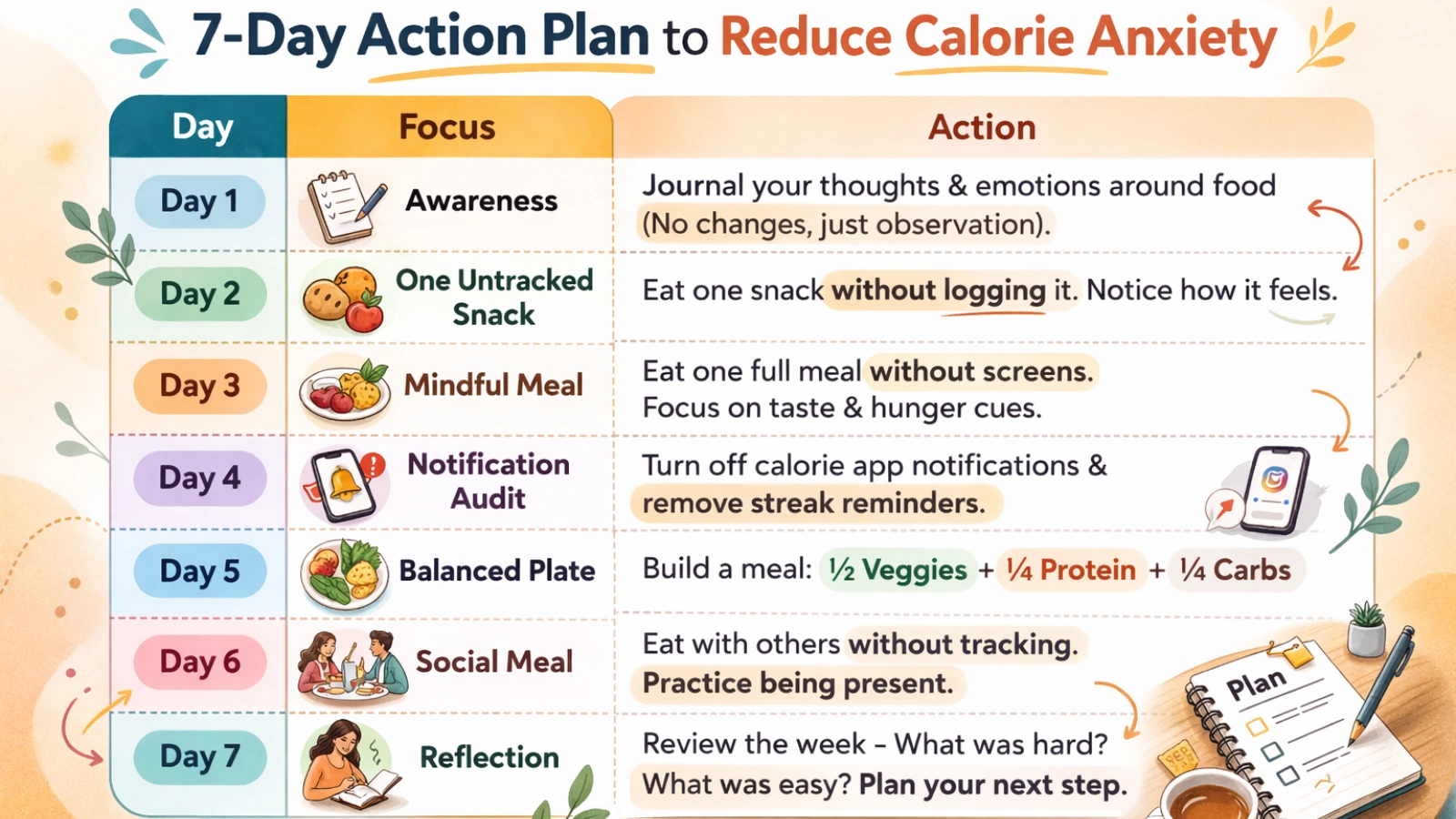
By the end of the week, the goal isn’t to have solved calorie anxiety, it’s to have built evidence that eating without obsessive tracking is survivable, and to have identified which strategies feel most relevant to your situation.
Building a Healthier Relationship With Food Calories
Understanding Calories Without Fear
Calories are a unit of energy, not a measure of moral worth. Your body needs a meaningful number of them every single day to function, to breathe, think, move, regulate temperature, and repair tissue. A calorie deficit produces weight loss; a calorie surplus produces weight gain; maintenance intake sustains current weight. That’s the full extent of what the number means.
What calories don’t measure is nutritional quality, satiety, how food makes you feel, or the social and cultural meaning of a shared meal. Building a working understanding of calories as a neutral piece of information, rather than a verdict on your choices, is foundational to reducing the anxiety they generate.
Alternatives to Calorie Counting Worth Exploring
If you want to move away from numerical tracking, several well-researched approaches can replace it. Intuitive eating is a framework built around reconnecting with internal hunger and fullness cues, removing food moral judgments, and eating in response to body signals rather than external rules. It has a substantial evidence base for improving psychological well-being around food.
Habit-based nutrition, focusing on consistent behaviors like eating protein at every meal, including vegetables regularly, and eating slowly, achieves nutritional adequacy without the need for tracking at all. For those who want some structure without numbers, flexible macro-lite approaches (rough protein targets, general carb and fat balance) offer a middle ground between obsessive tracking and complete intuition.
A Simpler Tracking Alternative
If you are not ready to step away from tracking completely but want something that feels less overwhelming, simpler tools can help ease the transition.
Calorie Tracker Buddy offers a more minimalist and user-friendly approach compared to many traditional calorie-counting apps. Instead of pushing aggressive targets, streaks, or constant alerts, it focuses on making food logging feel straightforward and less mentally demanding.
Key Features
Easy Food Logging: Quickly log meals without needing to break down every ingredient in extreme detail.
Clean, Simple Interface: The app layout is minimal and distraction-free, which helps reduce tracking fatigue.
Basic Calorie Awareness: Gives you a general view of your intake without overwhelming charts or pressure-based visuals.
Meal-Level Tracking: You can log full meals rather than obsessively entering every bite, which is helpful for people trying to avoid compulsive tracking patterns.
Beginner-Friendly Design: Works well for users who want a “simple calorie counter” rather than a data-heavy nutrition dashboard.
When To Seek Professional Help
Some experiences with food and calorie anxiety go beyond what self-help strategies can address, and recognizing those situations is important.
Red Flags That Warrant Professional Support
- Panic attacks or severe anxiety specifically triggered by food or eating situations
- Significant and unintended weight loss or weight fluctuation
- Active binge–restrict cycles that feel outside your control
- Purging behaviors, including excessive exercise as compensation for eating
- Food anxiety that is significantly interfering with work, relationships, or daily functioning
- Thoughts about food that occupy the majority of your waking hours
Who Can Help

A registered dietitian with experience in disordered eating can help you rebuild a functional relationship with nutrition without triggering further anxiety. A therapist, particularly one trained in cognitive behavioral therapy (CBT) or acceptance and commitment therapy (ACT), can address the underlying thought patterns that drive obsessive tracking. For more severe presentations, an eating disorder specialist or a multidisciplinary team combining medical, nutritional, and psychological support may be appropriate.
Reaching out is not an overreaction. Calorie anxiety exists on a spectrum, and getting support earlier, before patterns become more entrenched, produces better outcomes.
Can You Ever Use Calorie Counting Apps Safely?
Yes, but with boundaries. Calorie counting apps are genuinely useful tools when used flexibly, for a defined purpose, and with clear stopping conditions. Short-term tracking to build general awareness of portion sizes or nutritional patterns is different from indefinite daily logging with rigid targets.
Signs that you’re in a healthy relationship with a tracking app: you can skip logging a meal without distress, you treat the data as approximate rather than precise, you eat socially without stress, and the app feels like an occasional tool rather than a daily obligation.
If you’ve taken a break from tracking and want to return, the readiness markers to look for are flexibility, you’re comfortable with estimation rather than precision, and emotional neutrality around the numbers. If looking at a daily calorie total still produces strong anxiety or guilt, more time away from tracking is likely the right move.
Frequently Asked Questions
Is calorie anxiety real?
Yes. While it isn’t a formal clinical diagnosis, calorie anxiety describes a genuine and increasingly common pattern of food-related stress, guilt, and obsessive behavior. It exists on a spectrum from mild tracking fatigue to severe anxiety that significantly disrupts daily life. It deserves to be taken seriously regardless of where on that spectrum it falls.
Can calorie counting cause eating disorders?
Calorie counting does notdirectly cause eating disorders, but for people with existing vulnerabilities, it can be a contributing factor. Research suggests that rigid dietary tracking is associated with increased risk of disordered eating behaviors, particularly in younger people and those with perfectionist tendencies or pre-existing body image concerns. It can reinforce the rigid, rule-based thinking patterns that characterize many eating disorders.
How do I stop obsessing over food calories?
Gradually and with support, rather than all at once. The practical strategies in this guide, introducing untracked meals, practicing mindful eating, shifting focus to nourishment over numbers, and working on the emotional triggers behind tracking, are effective starting points. For more deeply entrenched patterns, working with a registered dietitian or therapist produces better outcomes than trying to manage them alone.
Are calorie counting apps unhealthy?
Not inherently. Used flexibly and for a defined purpose, calorie counting apps are neutral tools. They become problematic when the tracking itself becomes compulsive, when the emotional stakes around the numbers are high, or when the app’s features, streaks, targets, and alerts reinforce rigid rather than flexible eating behavior. The app isn’t the problem; the relationship with the app is.
What’s a simple calorie counter method that does notcause anxiety?
The simplest low-anxiety approach is logging meals rather than individual ingredients, using rough estimates rather than precise figures, and reviewing weekly totals rather than daily ones. This maintains general nutritional awareness without the obsessive detail that drives anxiety. For many people, eventually replacing numerical tracking with the plate method or intuitive eating principles produces even better results, both nutritionally and psychologically.